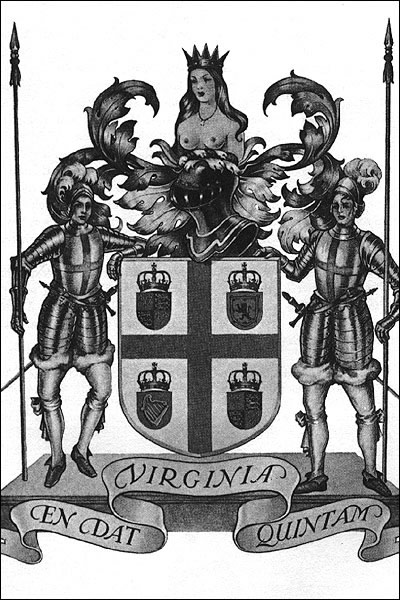
The Virginia Company Coat of Arms
Photo Credit:
Virtual Jamestown, Virginia Center for Digital History, UVA
My fascination for our Wyatt connection to Jamestown continues to grow.
I have no idea what Hawte and Sir Francis Wyatt knew of life in Jamestown as they made their plans to come over, but I suspect they assumed the worst was over.
They were wrong, of course.
I rented a great video from Netflix – “National Geographic: The New World – Nightmare in Jamestown.” Some of the following is from that. (This is raw material for my book, it’s fun to share.)
Do you realize:
Europeans had already been visiting this area of the new world for 100 years.
Spanish Jesuits established a mission in the Chesapeake Bay area in the 1570s; the natives killed them off in a few months.
In 1590, an English captain who returned with supplies (for the second attempt at a settlement) found everyone had disappeared without a trace.
In December of 1606 105 upper class Englishmen and workers left England for the new world on the Susan Constant, Godspeed and Discovery. One passenger died en route. Internal fighting started on the ships. There wasn’t much wind, so the journey across the Atlantic took four months instead of the usual three. That would try anyone’s patience. And then they had unrealistic expectations.
They didn’t fear the natives, they expected the natives would trade food for beads. As a result, they didn’t bring much in the way of supplies. (You have to wonder where they got their information on the native people.)
The natives were pissed at first sight. Powhatan had heard a prophecy that warned of a people who would come from the water; he was not amused.
The English feared the Spanish and docked their ships far upriver so they wouldn’t be spotted. Of course that left them surrounded by 14,000 Native Americans.
The English assumed technological superiority with their guns, but the natives could shoot ten arrows in the time it took to pull off one musket shot.
They had no clue about the climate and weren’t dressed for the weather; they wore wool and armor.
They arrived during the worst drought in many years. They were drinking water from the river, which was increasingly brackish. It’s thought this is probably why some died.
They feared Spanish spies within their ranks. According to the National Geographic video, that wasn’t the paranoia talkin’.
The upper class Englishmen didn’t want to share the work. In 1608 Captain John Smith instituted a “no work, no food” policy.
In October of 1608 the first two Englishwomen arrived with the second shipment of men and supplies. They were Mistress Forrest and her maid Anne Burras, who was 14. Anne’s marriage to a man ten years older was the first wedding in the new land. She and her husband went on to raise four daughters.
This is interesting, archaeologists think they found Mistress Forrest:
http://www.archaeology.org/9903/newsbriefs/jamestown.html
The winter of 1609 and 1610 was “the starving time.” 200 people ate dogs, cats, horses and poisonous snakes. Some even dug up corpses. One husband killed his wife and ate her. (He was burned to death for his crime.) That winter only 60 people survived.
Captain Smith bravely negotiated trade with Powhatan for the food that saw them through. Still, relations remained strained.
“Relations between the Powhatans and the English grew less friendly as the settlers moved to expand the colony. Settlers began to attack Indian villages, in some cases burning homes and fields. In one instance, they not only destroyed the whole town of Paspahegh, but also killed every Indian including women and children. This broke the most basic rule of warfare for the Powhatans and their attacks on the English became more severe. The situation continued to worsen until a colonist captured Pocahontas, a favored daughter of the chief Powhatan, in April 1613. She was taken to Jamestown where she remained a hostage for about a year, learning English and marrying her tutor, John Rolfe. Their marriage helped to secure a peace agreement between the two cultures for a while. This period of peaceful relations came to an end after the death of Pocahontas in England and the return of John Rolfe and other colonial leaders in May 1617. Disease, poor harvests and the growing demand for tobacco lands caused hostilities to resume.”
http://www.personal.kent.edu/~dfriend/powhatan.htm
By 1619, the colony was seeing profit from the sale of tobacco. The company gave the men land to build homes, but they had no women. So the company (The Virginia Company of London) arranged for mail order brides; the brides were paid for with tobacco.
That year the Virginia Company said that “…a fit hundredth might be sent of women, maids young and uncorrupt, to make wives to the inhabitants and by that means to make the men there more settled and less movable….” In 1620 the Virginia Company sent 90. In may of 1622 company records stated that “57 young maids have been sent to make wives for the planters, divers of which were well married before the coming away of the ships.”
Nice logo (“coat of arms”) Virginia Company. Tobacco leaves(?) and hooters?! There was sex in marketing even then. Well, I guess it was truth in marketing if you could trade your crop for a wife.
Our family arrived the following year. Hawte, Barbara and their infant son Edward accompanied Hawte’s older brother, Sir Francis Wyatt on the journey across the Atlantic to Virginia. They sailed from England on August 1, 1621 on the “George.”
For frame of reference, understand that THE FIRST PILGRIMS ARRIVED IN PLYMOUTH JUST ONE YEAR EARLIER.
Barbara must have been in the early stages of pregnancy during the crossing. I wonder if she simply thought she was seasick.
They arrived in October of 1622. Barbara was about three months pregnant.
What was it like in Jamestown at that time? “For the first twenty years or so, Jamestown dwellings were ‘rude shanties of such green timber and poor workmanship that they were constantly decaying.’(15) http://www.nwhm.org/online-exhibits/jamestownwomen/15.htm
The Indian massacre of Good Friday took place in March of 1622 – within five months of our family’s arrival.
“The paramount chief Powhatan died soon after in 1618 and the mantle of power passed officially to his brother Opitchapam, but it was a second brother Opechancanough who held the real authority. Opechancanough led a major raid on English settlements in March 1622, assuming that the English would react to such a brutal attack in Indian fashion and withdraw from the area altogether. Instead the colonists sent for reinforcements and counter-attacked.”
http://www.personal.kent.edu/~dfriend/powhatan.htm
Barbara had to have been heavy with child when 347 English men, women and children were killed throughout the Virginia colony. That was about one third of Jamestown’s total population.
Sir Francis Wyatt “rallied the defense of Jamestown which was attacked by Native Americans, during which the lives of some 400 settlers were lost and he then oversaw the contraction of the colony from scattered outposts into a defensive core.”
http://www.spiritus-temporis.com/francis-wyatt/
Barbara and Hawte gave birth to the first American born Wyatt – George – shortly after the massacre. Ladies, imagine going into labor in a place like that – after a tragedy of that magnitude.
“Childbirth was very dangerous for women. Jamestown was a de facto wilderness, and few trained doctors or midwives were available. Instead, female neighbors and relatives helped women through their labor.
Mothers had to steel themselves emotionally to the strong possibility that their babies would die. Disease spread easily, and so few sicknesses could be cured that children born in Jamestown had only a fifty percent chance of growing to adulthood. One quarter of infants born alive died before their first birthday. Worse, if a child did survive its early years, it was likely that he or she would never know at least one parent. By the age of nine, most children had lost one or even both parents. Orphans were a fact of ordinary life in Jamestown.”
http://www.nwhm.org/online-exhibits/jamestownwomen/16.htm
In 1625 Sir Francis, his brother Hawte and Hawte’s wife and two small sons returned to England to settle their father’s estate.
In 1639 Sir Francis returned to Jamestown to become Governor for a second time. He brought Reverend Hawte’s three sons and a daughter back with him. They are our American ancestors.
I hope you’ll take time to rent the National Geographic video. It helps us appreciate what they went through in those times.

 Sir Thomas Wyatt the Poet