Feeds:
Posts
Comments

A friend and long-time aficionado of Vikings and Druids pointed me to “the Viking Answer Lady” yesterday. He said I might find part of the information interesting. I won’t be using it in the book but I DO find it fascinating – especially since our pre-Rollo Norman/Viking generations ran on for many, many years.
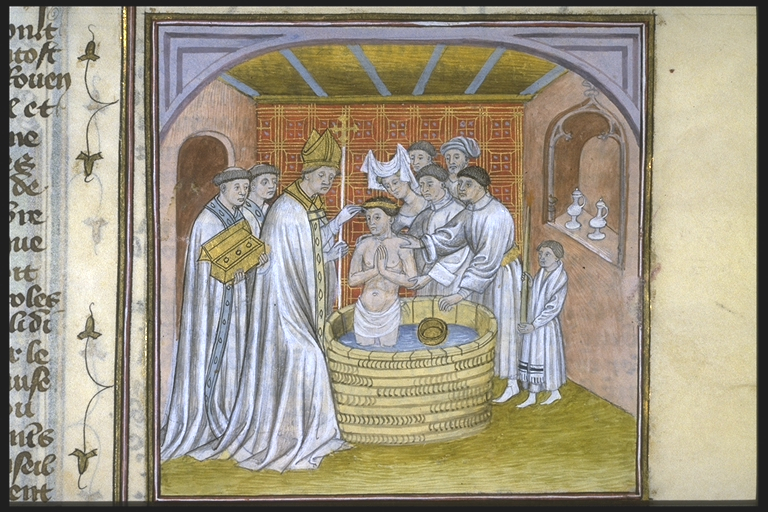
Rollo accepting Christian baptism.

Rollo accepting Christian baptism.

COURTSHIP: In Viking times courtship was fairly creepy. “The most important, unwritten rule of courtship was that the less a hopeful groom saw of his intended bride before entering into formal marriage negotiations with her family, the better his chances were of staying alive.”

MARRIAGE: Marriages had little to do with love and a lot to do with keeping people from killing each other.

A marriage “meant a chance for the bride’s family to make an alliance with one of the most important families… and thus be assured of powerful support in its dealings at the local thing and Alþingi“(Jacobsen, Position of Women, p. 40).Another very important function of marriages was not just the promise of economic gain or political advantage: often the Scandinavian wife served as a “peace-pledge,” bartered in marriage to guarantee the reconciliation between formerly feuding parties (Jenny Jochens, “The Medieval Icelandic Heroine: Fact or Fiction?” Viator 17 [1986]: p. 37). Anglo-Saxon literature in particular records this Germanic theme, identifying wives and queens as “peace-weavers,” who through childbearing wove together the blood of warring tribes, acted as a hostage for her family within the enemy camp, and sought to cool hatreds within her new family (Jane Chance, Woman as Hero in Old English Literature. Syracuse: Syracuse University Press, 1986. pp. 1-3).

ARRANGED MARRIAGES weren’t a problem for men because they had a lot of options. “Bed slaves” were available for purchase. (That wasn’t necessarily a good thing for the slave, who might be forced to join her “master” in death.)

Concubines were also perfectly acceptable. They were usually women of lower class than the men; as a result, they didn’t mind. And the wives didn’t seem to mind so much because the concubine was never allowed to marry the man due to difference in class.

Apparently the woman’s consent WAS an important factor in the arrangement. “While the law did not require that a woman consent to her marriage, it seems to have been a very good idea to get her approval, for in the sagas, ‘all five marriages made contrary to the stated will of the girl are unmitigated disasters, ending with the death, maiming, or divorce of the husband’”.

TRUE LOVE: Those who were truly in love were sometimes serious about until death do us part. “Saxo Grammaticus records the moving last speech of a man about to be hanged, as he speaks of his beloved:

‘There shall be one end for us both; one bond after our vows; nor shall our first love aimlessly perish. Happy am I to have won the joy of such a consort; I shall not go down basely in loneliness to the gods of Tartarus. So let the encircling bonds grip my throat in the midst; the final anguish shall bring with it pleasure only, since the certain hope remains of renewed love, and death shall prove to have its own delights. Each world holds joy, and in the twin regions shall the repose of our united souls win fame, our equal faithfulness in love ‘”(Saxo Grammaticus. Gesta Danorum. cited in Hilda R. Ellis-Davidson. The Road to Hel. Westport CT: Greenwood Press, 1943. pp. 53-54).

DIVORCES: Those who weren’t in love could easily end things. “The Arabic poet al-Gazal reported that he was told by a Danish queen that ‘jealousy was unknown in that country, and that women stayed with men of their own free will, and left them whenever they wanted to’ (Jacobsen, Sexual Irregularities, pp. 78-79). While this is not a completely accurate statement, examination of the sagas shows that women were often the ones who initiated a divorce.” (Frank, p. 478).

The Icelandic law code granted divorce on three conditions – in those cases where the couple gave each other “large wounds” of brain, body cavity of marrow; if one of the two was too poor to support themselves; and if the husband attempted to take his wife out of the country against her will.

SPOUSE ABUSE was not acceptable. “Slapping a spouse, especially in front of witnesses, was considered extremely humiliating (Williams, p. 106). The Gulaþing Law of Norway made special provisions against a husband slapping his wife: if a man struck his wife in front of witnesses, she could not only claim monetary compensation for the blows equal to what he would have received had another man struck him, the wife had the right to divorce the husband on top of the fine after the third slap (Jacobsen, Position of Women, p. 116). Slapping a wife is the most common reason given for a divorce in the sagas (Jochens, Icelandic Heroine, p. 39). Occasionally a woman did not feel that divorce was sufficient retaliation for the insult of a slap: Hallgerd in Njals saga was involved in the deaths of two husbands who made the fatal mistake of slapping her “(Magnusson and Palsspn. Njal’s Saga. pp. 59 and 123).

Cool stuff; check it all out here:
http://www.vikinganswerlady.com/wedding.shtml

So much emphasis is put on Sir Thomas Wyatt when it is his wife, Elizabeth Brooke, who gives the Wyatts their/our rich legacy.  Elizabeth’s line goes back beyond the Dukes of Normandy. The most exciting experience in putting this book together was learning that the Dukes of Normandy claim a line of descent from epic Norse and Icelandic sagas.  

Rollo, First Duke of Normandy

Rollo, the first Duke of Normandy was born about 860 and died about 932. Encyclopeadia Britannica states that Rolf was a “Scandinavian rover who founded the duchy of Normandy.

Making himself independent of King Harald I of Norway, Rolf sailed off to raid Scotland, England, Flanders, and France on pirating expeditions and, about 911, established himself in an area along the Seine River. Charles III the Simple of France held off his siege of Paris, battled him near Chartres, and negotiated the treaty of Saint-Clair-sur-Epte, giving him the part of Neustria that came to be called Normandy; Rolf in return agreed to end his brigandage. He gave his son, William (I) Longsword, governance of the dukedom (927) before his death.

Rolf was baptized as ‘Robert’ in 912 but is said to have died a pagan.”

(Courtesy of The Encyclopeadia Britannica Web Site prior to their reverting to a pay service.)

I found a wonderful website that takes us back to the earliest viking times.  Please see:  http://www.robertsewell.ca/normandy.html

Well, this was interesting.

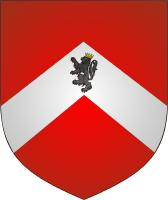
I had always heard that Sir Thomas Wyatt was a rogue, romantically speaking. Despite his marriage to Elizabeth Brooke, he was pursuing her second cousin, Anne Boleyn. (Elizabeth’s mother was Anne’s aunt. The Brooke coat of arms at left.)

Then today I saw that Wikipedia blames Elizabeth for problems in the marriage. They say she “separated from Thomas Wyatt and openly lived in adultery. He refused to financially support her, and after pursuing Anne Boleyn before her relationship with the King, he started a long-term affair with Elizabeth Darrell. In 1540, they were forced by Henry VIII to reconcile. This was as Wyatt had been accused of treason and only the begging of Catherine Howard had saved his life.”

Wikipedia is, of course, not monitored for accuracy. I discovered “Tudordaughter at blogspot.” This “distant cousin” has a completely different perspective:

“My family vine reaches back through thousands of years, through Kings and Emperor’s, but one of my most fascinating ancestors is by far my 11th great grandmother Elizabeth Brooke born in Cobhamhall, Kent England 1503 the daughter of Thomas Brooke the 8th Earl of Cobhamhall. She married my 11th great grandfather Sir Thomas Wyatt the poet who was madly in love with Anne Boleyn and wrote sonnets for her. This is of course while he was married to Elizabeth. Thomas and Elizabeth had two children a daughter Anne and my 10th great grand father Sir Thomas Wyatt the rebel who led the rebellion against Queen Mary advocating to put Jane Gray back in power as queen. He was later executed with Jane’s father Henry.

Elizabeth and Thomas had marital problems from the very beginning. I would largely suspect it had much to do with my great grandfathers roving eye, and love for Anne Boleyn. Thomas filed for a legal separation on the grounds of Elizabeth being “an adulteress” funny thing was that he could never produce any specific man that she was having an affair with. Nevertheless he kicked her out in 1537 forcing Elizabeth to live with her brother, Lord Cobham, refusing to pay support for his adulteress wife. Funny isn’t it that he was still carrying on his affair with Elizabeth Darrell. In 1541 Wyatt was arrested and his properties all confiscated. The Brooke family took advantage of this state of affairs and forced a reconciliation as a condition of Wyatt’s pardon. Apparently Lord Cobham had a lot of clout with King Henry. It doesn’t appear that Elizabeth ever went back to her home with Thomas. He would die in 1542.”

HANG ON, IT GETS EVEN MORE INTERESTING. I DID NOT KNOW THIS.

“It was early in 1542 that Lady Wyatt’s (Elizabeth) name crops up in Spanish dispatches as one of the three ladies in whom Henry VIII was said to be interested as a possible sixth wife. Any candidate had to be a direct descendant of Edward III. Elizabeth had an impeccable pedigree one that was even more princely than the King. However after his 5th wife Catherine Howard it was of up most importance that the King marry himself a wife with a spotless reputation. The scandal surrounding Elizabeth and Thomas caused the King to look elsewhere. Thank goodness for small miracles!!!!

Following Wyatt’s death Elizabeth would marry Edward Warner, Lord Lieutenant of the Tower. She died at the Tower in August 1560 and buried there within it’s precincts. Elizabeth was Anne Boleyn’s 2nd cousin, her grandmother would be Anne’s Aunt. I have to wonder what she felt about Anne and her husbands attachment to her. Did she hate her? Was this the reason she found herself a lover? I do not believe that Thomas, her husband ever wrote any sonnets for her.I love this woman, my great grandmother. What a life she led. She was right there in the middle of it all, married to one of Anne’s lovers, cousin to the queen, losing her son on the Tower Green.

According to Kelly Hart in her book Mistress’s of Henry VIII she is listed as one of his short term mistresses.”

(Note to self – buy that book.)

Learn more here:
http://tudordaughter.blogspot.com/2009/09/my-tudor-grandmother-elizabeth-brooke.html?

Research on other family members from that time period is similarly fascinating.

Stay tuned.

Micki


When my mother Beverly (Bolen) Lopez first told me she was researching the family tree, I expected she’d find bootleggers, petty criminals and a trollop or two.
Beverly (Bolen) Lopez

Beverly (Bolen) Lopez

Mom worked on the family tree “old school” for nearly 20 years.

She wrote letters, studied books and traveled to libraries and archives located within a few states of Michigan. When she hit roadblocks, she hired a professional genealogist.

Damned if she didn’t find our line to and past Sir Thomas Wyatt and Elizabeth Brook via her father, my Grandfather – Edwin Bolen.  Mom supplied “a skeleton” of names and dates; “thanks” to the economy, I finally have time to put some meat on the bones.

Naturally, there’s plenty to be found on the internet; but I’m working on putting the best of it in one place. The best stories of our shared people, places and times – from Europe to Virginia and Kentucky.

I’m not a genealogist, mom did all that. I’m not a historian. I am a professional writer and inspired descendant.

PLEASE NOTE! When I blog, I care more about passion than precision! Give me the benefit of a typo or two; I will pay attention to the grimbly details later.

Here on my blog I’m sharing the rough cuts, cool stuff, and “omigods”!

At first I thought I would self-publish strictly for family; but it’s so much work, I decided to create a book I can share with everyone. So far I have found lords and ladies, kings and queens, conquerors and vikings! I hope I have time to see some of these places – Allington Castle (a Wyatt home for generations), Hever Castle (where Anne Boleyn – cousin of our Elizabeth Brooke – grew up) – and The Tower of London where a number of our relatives did some time. A few managed to leave with their heads.

It blew my mind to hit the top level of Elizabeth Brooke’s line and find a Finnish connection.  For me, that’s full circle, it takes my grandfather’s line up and around to an early Finnish line; my beloved grandmother was Finnish.

I could feel the goosebumps.

I have some opinions, of course. I am disturbed that our male ancestors got more press than the females. That’s ridiculous since it appears that our best pedigrees come through Elizabeth Brooke and Matilda of Flanders.

My fellow Wyatt descendants, our ancestors have been honored and mocked, tortured and dismembered, crowned and recorded through history. Their romantic intrigues are  spellbinding. Sir Thomas Wyatt and his wife Elizabeth Brooke had what we’d call an open marriage. He had a thing for his wife’s cousin, Anne Boleyn. Henry VIII interfered with that and LATER developed a “thing” for Elizabeth Brooke!

Speaking of socially incestuous times – Matila of Flanders married William the Conqueror – her cousin! SHE ruled the land when he was off conquerin’. His love for her was epic; but it ended badly.

In those cases where I find good descriptions of the people and their times from archival sources, I’m including the stories INTACT. I have three reasons for that – the stories are beautifully told in classic style, the books themselves are rare/hard to find and there are no copyright issues.  A few of the best are available at great expense. I’ll make notes so you can find them.

What my mother found made her feel better about who she is. It has done the same for me and I have no doubt it will do the same for everyone who takes the time to learn more.

The research is totally addictive. I will share the best of it; hopefully there will be something here for you and yours.

Sincerely –

Cousin Micki

The photo of my mother was taken at the Bruce Crossing (Michigan) Fourth of July fireworks, 7/5/10.