Feeds:
Posts
Comments

Henry VIII


Some Sunday; I spent part of the day defending Henry VIII’s “honor”. I got into it with an English friend who insisted Henry died – and stank of – syphilis.  Pfffft.

Note to self: living in England does not make someone an expert.I haven’t read the syphilis theory in any of my books – so if I’m going to waste time rooting for the best of the latest information, I might as well share.

Mini refresher –

The fate of our Sir Henry Wyatt was tied to Henry VII.  They went to school together and became friends.  As adults, our Henry was loyal to Henry Tudor; he even endured two years of torture at the hands of kid-killer (?) Richard III.

Our Henry was greatly rewarded. (Please see what I wrote about Sir Henry in a previous blog. He is my favorite ancestor.)

The fate of Henry’s son Sir Thomas Wyatt the Poet was tied to Henry VIII

Henry VIII was born in 1491; our Sir Henry was made his guardian. 

In 1503 Sir Henry had his own son, Tom. There was too much of an age difference for them to have played together, but the king fancied himself a poet, musician and all-around renaissance man; he enjoyed battles of wits and liked having creative people around. They were friends.

Tom socialized with the king, pissed him off, competed for the same woman (Anne Boleyn) and was sent abroad to serve as ambassador. How convenient; get the competition as far away as possible.

Henry also had him thrown in the tower twice; and then he released him twice. I wonder if that was a record for Tudor times. 

So let’s take a moment to meet Henry VIII.  I’m guessing Henry and Tom could have passed for brothers. Both were over six feet tall, handsome and physically strong.

Check it out …

The psychology of Henry VIII.

http://www.youtube.com/watch?v=t3psDbRDACw&NR=1

I have to disagree with Philipa Gregory. She talks about Henry’s privileged childhood and says he started being careful with his money as he got older. 

First of all – based on the research I’ve done, Henry’s childhood was restrictive. His father and grandmother kept him on a very short leash with very little freedom or money.  When daddy died – look out.

Secondly – hello big spender. Henry spent much of his life – and his father’s money – keeping up with the lavish King Francis (of France). Well, of course that kind of spending is going to catch up with you. I didn’t matter that he ransacked the Catholic churches of England – he still had to start cutting back.   

When our ancestor Sir Tom (the Poet) traveled as Henry’s ambassador, he was frequently short of funds and Lord Cromwell had to pay bills in his absence. I need to find out whether that’s because Henry was short on cash or – as Lord Cromwell is known to have warned him  – because Tom was overly generous and lended money to friends. 

OK, back to Henry. If he lived today, what would he have in his fridge?  If yours has beer, lunchmeat and desserts, you have a thing or two in common. Remember – the water wasn’t fit to drink, he could only drink ale and wine. Food was fatty meats and sweets – hold the veggies:

http://www.youtube.com/watch?v=MbgcDxAQSgQ&feature=related

Henry had significant jousting and tennis injuries. (Note – Sir Tom jousted too!)
This segment even shows Henry’s armour.

http://www.youtube.com/watch?v=fFyEfXHCZgc&feature=related

Shortly before Henry’s last days, our ancestor Elizabeth Brooke was on the king’s radar for a potential seventh wife. Katherine Parr was getting too smart and too protestant for her own good. She was starting to annoy Henry and she had Catholic enemies at court.

By then he was truly fat and gross and smelled like pus – so Elizabeth dodged a bullet; ok, an axe.  She couldn’t have passed inspection anyway; she left our Sir Tom for another man and they say she lived openly in adultery. She wouldn’t have passed Henry’s new laws that required future queens to be morally upstanding.

Perky young Katherine Howard taught him that lesson the hard way. Her alleged whoring before and during her time as Henry’s fifth queen had made a total fool of the old king; so he had her beheaded – of course.

Rather than his usual fleeting twinge of remorse, he was sad for months.  

Fortunately, Katherine wised up in time to save herself and her ladies. She was a genuinely loving woman who cared about him and comforted him in his old age. By then Henry’s health problems included constipation, gout, insulin issues and problems from his old jousting injuries. 

This segment talks about how they think he died.

http://www.youtube.com/watch?v=me8yqOqAkuw&feature=related
 
After his death, Henry’s body was put in a lead coffin; during  transport, the edges loosened and it burst. That night his bodily fluids dripped onto the floor of Syon Abbey. When plumbers came to make repairs in the morning, a dog came in with them … and licked it up. 

In 1532 – when Henry was trying to divorce Katherine of Aragon so he could marry Anne Boleyn – there was a prophecy. Friar Peto warned that if he succeeded, the dogs would lick his blood. 15 years later they did.

Henry wanted a monument; well, it’s hard to command your minions when you’re dead. This is where the memorable monarch rests.

http://www.youtube.com/watch?v=WAenNzP9Y-k&feature=related

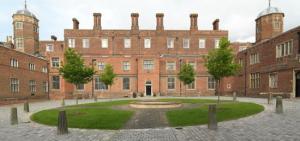
Birthplace of Elizabeth Brooke

Elizabeth Brooke’s birthplace: http://www.cobhamhall.com/historic-house

She was a bit of a phantom; so little information exists.  The Wyatts were friends and neighbors of the Boleyns. Elizabeth was one of their relatives.

Maybe that’s how she and Tom met. We don’t know why she left him after their son was born. They say she lived openly with another man. They also say Henry VIII was considering her as a potential seventh wife as he was reaching the end of his days.

We also know that when Thomas Wyatt and Elizabeth Brooke mixed lines, they gave us benefit of her bloodline. Our ancestors were Vikings, kings and queens.

I got carried away and added descriptions to the ancestors I know by heart. If any of the dates don’t look right, please send me an email; this is really tedious and it’s easy to make mistakes.

When I document how many children they had, remember that few survived in those days.

Our line through Elizabeth Brooke:

Rolf Ragnvaldsson, a.k.a. Rolf the Viking, Rollo the Ganger and Rollo of Norway
Rolf’s own tree includes legendary Vikings. (I worked it up – if anyone’s interested I’ll post it.) Rolf was born circa 846/860. He was among the Viking leaders who laid siege to Paris; instead of paying him off – which was the custom – French King Charles III cut him a deal to protect instead of attack; Rolf became the First Duke of Normandy and was baptized ‘Robert’ in 912. He married Poppa de Valois, granddaughter of Seigneur Pépin (II), Count of Peronne, a great grandson of Charlemagne.  (Rolf had other wives and many more children.) In 927 he gave his son, William (I) Longsword, governance of the dukedom. Rolf is said to have died a pagan in 932.

William I “Longsword”, 2nd Duke of Normandy (893-942)
m Adele of Bretagne (who died after 933).

Richard I “the Fearless”, 3rd Duke of Normandy (933-996)
m Gunnora (about 936 to about 1031)

Richard II, “Richard the Good” – 4th Duke of Normandy
Born 962 in Normandy, France; died 28 Aug 1027 in l’Abbaye de Fecamp.
m Judith of BRITTANY, a.k.a. the Duchess of Rennes (982-1017) in 1000
Have fun with this…
Pedigree resulting from Richard: HM George I’s 18-Great Grandfather, HRE Ferdinand I’s 14-Great Grandfather, U.S. President George Washington’s 21-Great Grandfather, PM Churchill’s 24-Great Grandfather, HM Margrethe II’s 25-Great Grandfather, Agnes Harris’s 20-Great Grandfather, and Osawatomie’ Brown’s 24-Great Grandfather.  See source: http://fabpedigree.com/s068/f017515.htm
Richard II and Judith of Brittany had six children, including …

Robert “the Devil”, 5th Duke of Normandy
Born 999 in Normandy, France. Robert didn’t have any legitimate sons through his wife, so he asked Norman leaders to honor his 7 year old illegitimate son as heir should anything happen to him. Robert died in Nicaea June 22, 1035 while on pilgrimage to Jerusalem.  They kept their word – but it wasn’t easy to keep the boy safe from assassins.
Harlette (Herleva) De Falaise (1003-1050) was Robert’s mistress. They had two children, including William the Bastard – who would earn the title …

William 1 the Conqueror, Norman King

Born 1028, died September 9, 1087.
He won the throne of England in the Battle of Hastings
(After Hastings his men won lands and properties. William’s half-brother – the notoriously not-so-pious Bishop Odo – claimed Allington Castle; many years later it was purchased by our ancestor Sir Henry Wyatt.)
William’s queen was Matilda of Flanders, a direct descendant of Alfred the Great. He was 6’ tall, she was tiny, about 4’ tall. Matilda was born around 1030, died 1083. Both of their tombs were desecrated by people seeking jewels and riches.
The king loved his queen and they had nine children, including…

Henry I Beauclerc, King of England
(Called Beauclerc because he was scholarly)
Born September 1068 and died 1 December 1135.
Henry married Matilda (1079 – 1118), a Scottish princess on November 11, 1100 in Westminster Abbey, London, England.  Her original name was Edith; she changed it to please the Norman barons. She was a descendant of King Edmund II.
Henry I and Matilda had four children, including …

Matilda the Empress Queen
She was born Feb 1102 in London
First she married German Emperor Henry V, who died in 1125.  Then she married Geoffrey V Plantagenet, 9th Count on 22 May 1127 in Le Mans Cathedral, Anjou.  (He was born 24 Aug 1113, died 7 Sep 1151).
Empress Matilda died 9/10/1167 in Notre Dame de Pres.
Matilda and Geoffrey had three children, including …

Henry II Fitzempress, King of England
He was born 25 Mar 1133 in Le Mans, Maine.
Henry married Eleanor of Aquitaine, Duchess on 18 May 1152 in Bordeaux Cathedral.
Eleanor was born 1122 in Chateau de Belin, Guinne, France.
Henry was crowned King 25 Oct 1154.
Henry died 6 Jul 1189 in The Great Castle of Chinon in Touraine and was buried in Fontevrault Abbey in his native Anjou.
Eleanor died 1 Apr 1204 in Fontevraud Abbey, Maine-et-Loire, France and was buried in Fontevraud Abbey, Maine-et-Loire, France.
Henry and Eleanor had 11 children including …

John Plantagenet, King of England
John was born 24 Dec 1167 in Beaumont Palace near Oxford.
He was crowned King 27 May 1199. John married Isabella of Angoulême Taillefer on 24 Aug 1200 in Angouleme Bordeaux. Isabella of Angoulême Taillefer was born 1180 in Angoulême, France. She died 31 May 1246 in Fontevrault and was buried in Fontevraud Abbey.
John died 18 Oct 1216 in Newark Castle, Nottinghamshire and was buried in Tomb in Worcester Cathedral.
They had five children including …

Henry III, King of England
He was born 12 Oct 1207 in Winchester Castle, Hampshire, England.
Henry was crowned 28 Oct 1216.
Henry III married Eleanor of Provence Berenger on 4 Jan 1236 in Canterbury Cathedral, Canterbury, Kent.
Eleanor was born 1223 in Aix-en-Provence, France.
Henry died 16 Nov 1272 in Westminster Palace London England and was buried in Westminster Abbey, London, England.
Eleanor died 24 Jun 1291 in Amesbury Abbey, Wiltshire and was buried in Convent Church, Amesbury.
Henry and Eleanor had 9 children including …

Edward I (Longshanks), King of England
He was born was born 17 Jun 1239 in Westminster Palace, London England.
Edward married Eleanor of Castile on 18 Oct 1254 in Abbey of Las Huelgas, Burgos, Castile. Eleanor was born 1244 in Castile, Spain.
Edward died 7 Jul 1307 in Burgh-by-Sands and was buried in Westminster Abbey, London, England. Edward was crowned 1274 in Westminster Abbey.
Eleanor died 24 Nov 1290 in Herdeby, Near Grantham, Lincolnshire and was buried in Westminster Abbey, London, England.
They had 16 children, including …

Edward II, King of England
He was born 25 Apr 1284 in Caernarvon Castle.
Edward was crowned in 1307, deposed 20 Jan 1327.
He married Isabella of France on 25 Jan 1308 in Boulogne.  Queen Isabella was born in 1292 in Paris.
Edward died 21 Sep 1327 in Berkeley Castle, Gloucestershire and was buried in Gloucester Cathedral.
She died 22 Aug 1358 in Castle Rising, Norfolk, England and was buried in Grey Friars Church, Newgate, London.
They had five children, including …

Edward 111 King of England
He was born was born 13 Nov 1312 in Windsor Castle, Windsor, Berkshire, England. Edward was crowned at Westminster Abbey 29 Jan 1327.
Edward married Philippa of Hainault on 24 Jan 1328 in York Minster. She was born 24 Jun 1311 in Valenciennes.
He died 21 Jun 1377 at Sheen Palace Richmond and was buried in Westminster Abbey, London, England.
Philippa died 15 Aug 1369 in Windsor Castle, Windsor, Berkshire, England and was buried in Westminster Abbey, London, England.
They had 14 children – some died as infants and one died of the Black Death. One surviving child was …

John of Gaunt, Plantagenet Duke
He was born Mar Mar 1340 in St Bavon’s Abbey, Ghent, Flanders.
He married Constance of Castile for political and dynastic reasons. After she died he married his true love Katherine to legitimize their relationship and their children.
(Katherine’s sister was the wife of Geoffrey Chaucer.John married Catherine Swynford Roet Duchess on 13 Jan 1396 in Lincoln Cathedral. King Richard legitimized their children under English law, but stipulated they were not eligible for royal succession. (That didn’t stop Katherine’s great-great grandson from getting himself crowned Henry VII.)

Between them, John and Katherine started the Tudor and Yorkist Royal Houses; most of the European Royal Houses trace their origins back to them through intermarriage.
Katherine and John fulfilled an ancient prophecy of Merlin: “thou shalt get kings though thou be none!”

Their son John Beaufort (1372 to 1409) had two sons Henry, Earl of Somerset and John, Duke of Somerset who fathered Margaret Beaufort (mother of Henry VII).
Their daughter Joan Beaufort (1379 to 1440) – see below – had as her second husband, Ralph Neville of Derby, 1st Earl of Westmoreland. Joan’s daughter, Cicely, married Richard, Duke of York and was mother to Edward IV and Richard III.

John died 3 Feb 1399 in Ely House Holborn and was buried in St Paul’s Cathedral, London, England. Catherine died 10 May 1403 in Lincoln and was buried in Lincoln Cathedral.

Joan De Beaufort
Joan was born 1379. She married Ralph Neville, 1st Earl of Westmoreland on 3 Feb 1396. Ralph was born 1363.  Joan died 13 Nov 1440 in Howden, Yorkshire and was buried in Lincoln Cathedral. Ralph died 21 Oct 1425 in Raby Castle, Durham and was buried in Staindrop.

They had 14 children, including …

Sir Edward Neville who was born in 1417. Edward married Catherine Howard on 15 Oct 1448. Catherine Howard was born in 1414, the daughter of Sir Robert Howard of Stoke Neyland and Margaret Mowbray. Her grandparents were John Howard, Sheriff of Essex and Alice Tendring. The Boleyns are also related to the  Howards.

He died 18 Oct 1476. She died after 1478.  They had two daughters, including …

Margaret Neville
Margaret was born about 1455 in Raby, Durham, England; she died 9/30/1506.
She married John Brooke, Lord Cobham. He was born 10 Dec 1447 in Cowling, Kent, England and died March 3, 1511 or 12.
John Brooke and Margaret Neville had one son …

Thomas Brooke, Lord Cobham
He was born about 1465 in Cowling, Kent, England.
Lord Cobham married Dorothy HEYDEN or Haydon about 1494. She was born 1465 in Beaconsthorpe, Norfolk, England. Dorothy was the daughter of Sir Henry Heydon and Ann Boleyn; Anne Boleyn was the daughter of Sir Geoffrey Boleyn.
Thomas died July 1529 in Stringston, Somersetshire, England.
Elizabeth was related to Anne Boleyn on her mother’s side; Sir Geoffrey Boleyn, Lord Mayor of London, was her mother’s grandfather.
Thomas Brooke and Dorothy Heyden or Heydon had two children, including …

Elizabeth Brooke
She was born 1503 in Cobham Hall, Kent, England; her well-known brother George was born in 1500. Elizabeth married Sir Thomas Wyatt, the Poet. He was born 1503 in Allington Castle, Boxley, Kent, England; Sir Tom died 1542 on the road while working on behalf of the king. Elizabeth died in 1560.
Elizabeth Brooke and Sir Thomas Wyatt had one son …

Sir Thomas Wyatt the Younger.
Born 1520 in Allington Castle, Boxley, Kent, England
Married Jane Hawte in 1537 at Boxley, Kent, England; Jane was born in 1522.
Sir Tom led part of a rebellion, was captured by Queen Mary’s forces and died a traitor’s death 11 APR 1554 in the Tower of London, London.
Sir Thomas Wyatt the Younger and Jane Hawte had three children, including …

George Wyatt was born 1550 in Allington Castle, Boxley, Kent, England
m Jane Finch 8 OCT 1582 in Caswell, Kent, England. Jane was born around 1555.
George was first biographer of Anne Boleyn. He died died 16 SEP 1623 in Ireland
George and Jane had three children – Francis Wyatt, Haute/Hawte Wyatt and Isabel Wyatt.

Francis and Haute Wyatt
went to Jamestown shortly before the Indian massacre; they returned to England after their father’s death to settle his estate; Francis wound up going back to Jamestown with Haute’s children and stayed.  (See my previous post on Jamestown.)

Henry VIII's true wife.

Forgive my rants and ramblings. “The Tudors Wiki” has an ongoing debate about which of Henry’s wives had it worse.  I say it was Katherine of Aragon.  

(The Tudors is a “visually lush but historically loose” series on the life and wives of Henry VIII. Our ancestor Sir Thomas Wyatt is an integral part of it. You can see seasons 1 and 2 on demand via Netflix; seasons 3 and 4 are available on DVD.)

I suspect 80% of “The Tudors”‘ research came from one of my favorite references – Alison Weir’s “Six Wives of Henry VIII.”

The casting is brilliant, but they were a little stuck in stereotypes. They have the Spanish queen played by Maria Doyle Kennedy who has pitch black hair and fair skin;  check it out: http://tudorswiki.sho.com/page/Queen+Katherine+of+Aragon

This actress is awesome in the role but the real queen had fair skin and reddish hair. 

In my research I find myself growing very attached to some of these people. Katherine – like Sir Henry Wyatt – is  a favorite. But it didn’t “feel” right because I’m supposed to be writing about our ancestors and their connections, ya know? So you can imagine my delight in finding she does have a connection to us. 

Henry VIII elbowed our Thomas out of the way so he’d have a clear shot at Anne; then Tom fell in love with Elizabeth Darrel, Katherine’s Maid of Honor. (I’m going off memory so don’t hold me to details in this blog.)

Katherine of Aragon

It’s funny, the English had not yet encountered a strong, capable Queen Regnant but that’s exactly what Katherine’s mother was. Isabella I of Castile was at war and in the saddle the day before Katherine was born; she gave birth and rode off again the next morning, leaving the infant with a wet nurse.

Henry VII saw Isabella and Ferdinand as movers and shakers; he wanted to  strengthen his claim to the throne by marrying his oldest, Arthur, to their Katherine. They were betrothed as toddlers.

I can’t remember how old Katherine was when she finally made the journey to England. I think early teens.  She met with horrific storms en route and it took about three months to get there. I wonder if she saw that as an omen.

When she landed, she was entering prime child-bearing years. Arthur died of sweating sickness shortly after the wedding. Katherine was sick too – but she survived.

Imagine being a young girl, widowed, alone in a strange country. I read somewhere that her parents taught her to drink wine before she left home because the English couldn’t drink their water; it was unfit for human consumption.

Henry VII promised Isabel and Ferdinand that he would treat Katherine as his own daughter, but he used the young widow as a financial bargaining chip instead. He wanted dowry. He arranged for her betrothal to his son Henry, butyears later it was secretly withdrawn. He got stingy with her and she had to beg for clothes and money for the few loyal servants she had left.

Henry VII bears much blame for Katherine’s sad life because he wasted at least six of her prime child bearing years. Maybe if he had stepped aside, his son would have had his sons. Sure he would have strayed, but Katherine might have kept her crown and lived a more peaceful life. 

By the time Henry VII died and the young Henry VIII accepted his brother’s widow as wife, she was 23 years old – he was 18. Her first son was born on New Year’s Eve – a little boy who died in less than 60 days.

More miscarriages … imagine the rush of hormones, the depressions, the grief. Queens were glorified breeders. I read that she gave off an unpleasant odor after every pregnancy and Henry couldn’t stand the thought of getting close. Plus she was getting old quickly. Who wouldn’t? 

The royal couple’s daughter Mary didn’t count in the grand scheme of things because the English could not remember a time when they’d had an effective queen regnant.

Henry VIII’s father cared about money and establishing the Tudor dynasty. Henry VIII cared about putting on a big show and having a legitimate son or two to perpetuate the lineage. 

I think it’s probably true that he felt he had sinned by taking his brother’s wife; but the measures he took to rid himself of this pious woman were despicable.

There is a scene in The Tudors where Katherine takes a nighttime carriage ride to a cathedral to pray for a son. She steps out of the carriage barefoot onto cold wet stones … it’s a powerful visual.   

Katherine was the proud daughter of a powerful queen. Katherine herself was queen regnant for six months at the Battle of Flodden (Henry was busy in France at the time; nobody talks about that because he took credit for her win over the Scots.) 

She was a was a good woman who genuinely loved her God, her husband and her daughter. 

Towards Katherine’s end, Henry told Katherine and Mary they could see each other if they would acknowledge Anne as queen; they would not. Who could blame them?

All those miscarriages, one beloved daughter – then a husband whose affections grew cold to the point where he flaunted her successor.  When they opened her up after her death, they found “something black” on her heart. They say now that was a cancer. Well, abuse feeds cancers. I say any way you cut it, she died of a broken heart.

Yes, I believe Katherine had it worst.

I truly wonder why the Catholic church sainted Sir Thomas More (who burned Protestants at the stake) but not Katherine? Her faith, integrity and loyalty were unshakable.

If you watch the Tudors, you’ll see the scene where Katherine dies and her maid Elizabeth Darrel hangs herself; it didn’t happen that way. Elizabeth D. did not commit suicide.

Katherine wrote Elizabeth D. into her will, hoping she would find a good match. She already had a match – our ancestor, Sir Thomas Wyatt.   He even translated some Latin for Katherine. I wonder how well he knew her.

Anne Boleyn was the victim of her own ambition. I don’t care if we are related, I believe Anne’s karma played out in her lifetime; fortunately it did not extend to her daughter Elizabeth.

Elizabeth D. lived with Sir Tom at Allington until his death. (He died while traveling on behalf of the king.)  She had sons by him; one died with his half-brother Sir Thomas Wyatt the Younger at or after the rebellion.

Here’s something cool … last week I learned that Henry VIII gave Anne of Cleves three residences in appreciation for her willingness to step aside as wife. (She had to be giddy with relief!!) One of those residences was Hever, home of Anne and the Boleyns. Anne of Cleves also took an interest in little Elizabeth.

I wonder if the two spent time together at Hever. I can’t wait to learn more.  I have a soft spot for bastards who turn out ok:-)

(I am one.)

The man is hilarious. Be sure to watch all four segments.

http://www.youtube.com/watch?v=DeiW_bWZ2Is&feature=related

Anne and Elizabeth

  
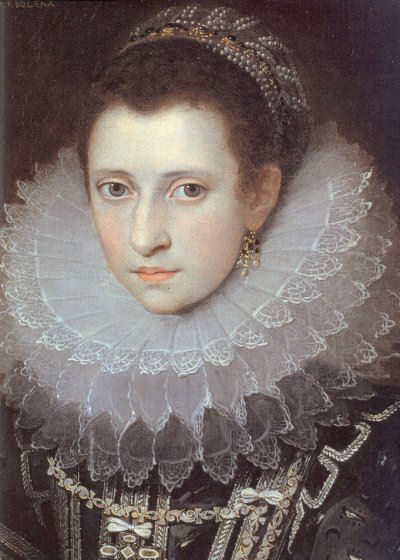
I could just stare at these paintings: Anne Boleyn by Frans Porbus the Younger and Elizabeth Tudor, her daughter, by William Scots. I discovered the one to the left in “Elizabeth & Mary – Cousins, Rivals, Queens” by Jane Dunn.

I read online that there is no certainty that Porbus’ painting is of Anne, but the resemblance to Elizabeth seems evident in the eyes, lips and chin. (I want to put images like this in the book, but I’m worried about expense to the reader; I may make two versions.) 

A person could easily have mixed feelings about “our cousin” Anne Boleyn, but not her daughter. Not me, anyway. As a young girl she saw the women who loved her fall to the blade and went on to develop a backbone of steel. She knew when and how to reinvent herself as necessary. She is an inspiration.

I haven’t posted in a while, I have been buried in books. Nothing I have read confirms that Sir Thomas Wyatt had an affair with Ann; it is clear that he loved her.    

When Henry VIII let it be known that Anne was his, Sir Thomas started up with another – Elizabeth Darrel, who was Maid of Honor to Katherine of Aragon; Elizabeth was steadfast to the end and was in the queen’s will.

There’s another lady worthy of respect – Katherine of Aragon.  

Elizabeth had three children by Sir Tom – one who died with his half-brother as a result of Wyatt’s Rebellion. So, Wyatt cousins … there are more of us than I thought. 

Burning questions? Oh, heck yeah.

How did Sir Thomas feel about Katherine of Aragon?
How did he genuinely feel about the king’s Great Matter?
When (and why) did Cromwell develop such a deep affection for Sir Thomas? 
How did Sir Thomas maintain respect for a king who grew increasingly violent towards those he loved? 
How did he maintain relationships with friends who hated each other?

THE BIG QUESTION: Why was Anne Boleyn so important to the Wyatts that – several generations after her death – George Wyatt would become her first biographer? Was it because she was a reformer, or was it more than that?  

So many mysteries, so little time.  If anyone has clues – or has contact information for our esteemed “cousin” the Earl of Romney, let me know! 

Meanwhile, I’m workin’ on it as best I can.


Sir Henry Wyatt, Knight

Sir Henry Wyatt, Knight


These blogs are previews of my book as a work in progress.  This is painstaking stuff, so please honor my copyright – mickisuzanne©

Henry Wyatt was born in Yorkshire, England in 1460. His parents were Richard Wyatt and Margaret, the daughter and heir of William Bailiff.

Both Henrys were born during the War of the Roses – a series of battles between two rival branches of the Royal House of Plantagenet. The houses of Lancaster were later signified by a red rose, the houses of York were later signified by a white rose.

Henry Tudor’s Mother

Lady Margaret Beaufort was 12 years old when she was married to Edmund Tudor – aged 27. She was only thirteen when Henry Tudor was born and the delivery was so difficult she was told she probably couldn’t have more children. Then she was widowed before her son was born. Edmund was captured by Yorkists and imprisoned at Caermarthen. Plague broke out and he died two months later.

Lady Margaret became an intelligent, ambitious woman. Despite other marriages, Henry remained her only child. She would exert a powerful influence on him and his all of her life.

Henry Tudor’s Father

Henry Tudor’s father Edmund and his Uncle Jasper were borne of a scandalous affair between Queen Katherine of Valois and Owen Tudor, her Welsh Clerk of the Wardrobe. It is said that the dowager queen had married him in secret.  Whatever – Henry VI, legitimate heir to the throne, made his half-brothers earls.  Edmund became Earl of Richmond and Jasper became Earl of Pembroke. Both were dedicated to the Lancastrian side of the War of the Roses.

Henry Tudor spent years in exile. Henry’s grandfather, Owen Tudor, was executed by Yorkists. Other Beaufort relations died in bloody battles against the House of York. In 1471 his half-uncle, King Henry VI was captured and murdered after the Battle of Barnet. The next closest heir in the Beaufort line was Henry’s mother Margaret; since a female heir was unacceptable under those circumstances, her son Henry was in grave danger.

The Beaufort Issue

Lady Margaret Beaufort was the great granddaughter of John of Gaunt. (We share this ancestry through Lady Elizabeth Brooke.) John of Gaunt was a member of the House of Plantagenet, the third surviving son of King Edward III of England and Philippa of Hainault. He was called “John of Gaunt” because he was born in Ghent (in today’s Belgium), then called “Gaunt”.

In terms of ascendancy, there was a big problem with the Beaufort line. It started with a young girl Katherine who was made third wife to Hugh Swynford, a Lincolnshire knight. After his death she a widow for many years. During that time she became the mistress of John of Gaunt. Their four children were surnamed Beaufort. After they finally married in January 1396, their children were retroactively legitimized by the Pope and Richard II. HOWEVER: Henry IV had added a provisio that no Beaufort should ever succeed to the throne.

When Edward IV died in 1483, he left his throne to his twelve-year-old son, Edward V. Edward ruled for two months, with the “help” of his Uncle Richard, who was named “Lord Protector”.

The Tyranny of Richard III

Richard would come to be known as one of England’s most irredeemably evil kings.  Shakespeare, Thomas More and others described him as deformed – but that was a time when deformity and evil were thought to be one in the same.
Shortly after Edward IV’s death in April, a propaganda campaign insinuated that Edward’s marriage had been invalid and his sons were therefore bastards, ineligible for the throne.

In June the claims were endorsed by an assembly of lords and commoners. On June 26 – the day after the assembly – Richard began to rule. In July he was crowned Richard III.

In August, both of Edward’s sons disappeared.

If you vaguely remember a story about the two princes who “mysteriously disappeared” from the tower, this is that. The boys were 12 year old Edward V and his nine year old brother Richard, Duke of York. They disappeared in August of 1483, two months after Richard was crowned. It was widely assumed that if Richard didn’t kill them himself, he had it done. Their bodies have never been found.
That same year, Jasper won support for an invasion scheme. The timing seemed right, but the weather was against them. Around this time Henry Wyatt stepped up by taking part in the Duke of Buckingham’s failed revolt against Richard III.

In “A Sketch of the Life of Sir Henry Wiat” (written in 1963 by Eric Norman Simons) the author wrote that Henry was “…remarkable because, though Yorkshire born, he supported the cause of Henry Tudor, the Lancastrian who claimed the throne of England. For this he had been jailed in Scotland in ‘stocks and irons’ for two years by Richard III, who is said to have watched him undergo torture.”

Tortures were designed to allow the prisoner to live long enough to confess pretty much anything they wanted confessed before the individual died. The medieval arsenal for infliction of agony was beyond imagination; in coming years it would play a starring role in the Spanish Inquisition.

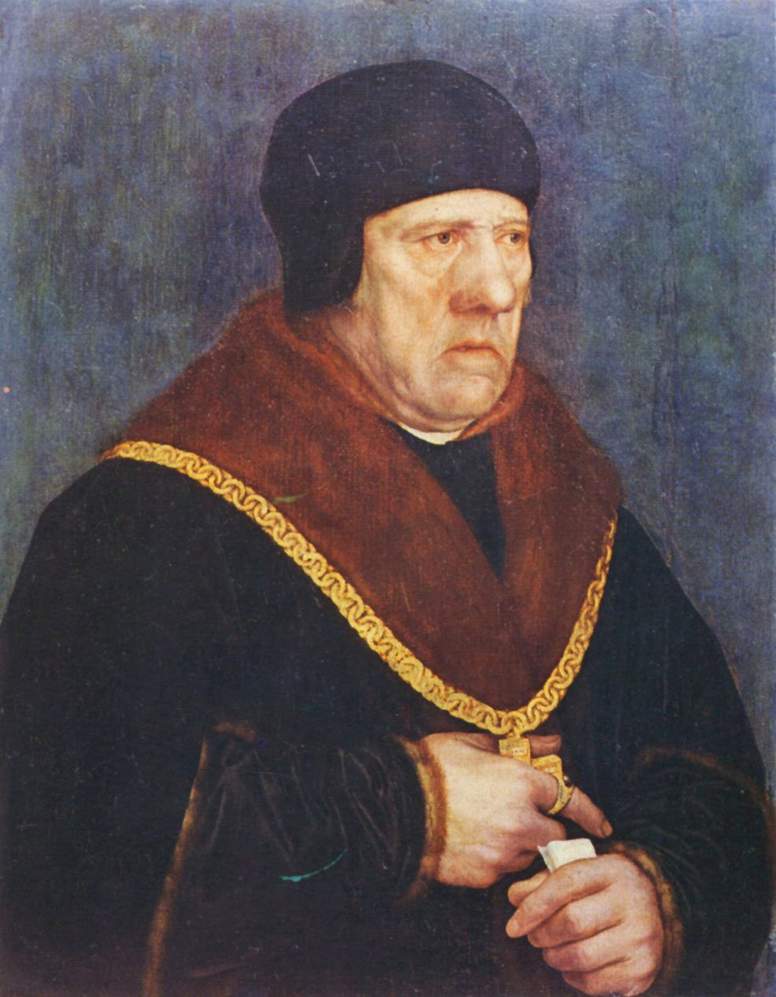
Henry was racked; that involved being tied across a board and bound by the ankles and wrists. Rollers would pull the body from opposite directions, resulting in stretching and extreme pain. The severity of the torture depended on the “crime” and social status of the victim.  In prolonged use, limbs would be dislocated or torn from their sockets.  Henry was also tortured with “barnacles”. The victim’s upper lip was pulled through a noose, tightened and twisted until the prisoner was in absolute agony. In some cases, it resulted in mutilation.

Judging from this painting of Sir Henry years later, it appears that may have been the case.

Henry was steadfast through all of it. According to tradition, Richard lamented that his own servants “had not such fidelity.”

Sir Henry’s “Caterer”

During his imprisonment Henry was on the verge of starvation, sleeping in tattered clothing on a thin straw mat in a cold room. Simons shares one account of a family legend. “Among other things, he was forced to swallow mustard and vinegar, and was on the verge of death from starvation. Then, so the story went, he made a pet of and fondled a stray cat, whom he ‘laid … on his bosom to warm him’. Puss grew so attached to him that each morning she deposited at his feet a pigeon pilfered from a neighbouring dovecote, which was later cooked for him by his compassionate jailer.

The family of Wyatt cherished for many years a half-length portrait of Henry in his cell. There in the picture, sure enough, is the cat, dragging through the grating of the cell a pigeon, which she is about to deliver to the prisoner. The painting is, however, not contemporary, having been produced long afterwards. It is, nevertheless, recorded that thereafter Henry Wiat ‘would ever reck much of cats’.

In fact, as a token of gratitude, he introduced to the dovecotes of Allington castle a strain of brown pigeons from Venice, which are as numerous there today as in his own time.”

Henry Tudor had not forgotten his friend.

In August of 1485 Henry Tudor and his forces landed in South Wales and headed east to do battle with Richard. Henry was sorely outnumbered at Bosworth, but Richard suffered a personal defeat – several of his most important lieutenants defected.
One account states: ”When the Standard of the fugitive Earl floated on the field of Bosworth, Wyatt found means to join it. When the Usurper had fallen on Bosworth field, one of the first acts of Henry VII was to liberate Henry and raise him from the private gentleman to the highest honours at Court.”

Agnes Conway describes what happened afterwards in “Henry VII’s relations with Scotland and Ireland”:
“The Earl of Richmond anon after he was crowned King entertained (Henry Wyatt) then coming out of imprisonment and affliction in Scotland first with most gracious words unto himself and then with this speech unto the Lords. Both I and you must bid this Gentleman heartily welcome, had not he above human strength or example also shewed himself our constant friend, neither had I enjoyed now the Crowne, nor you that Peace and prosperitie, and honour which you now possess.”

It is said that the king told Henry “Study to serve me and I will study to enrich you.” And that’s exactly what happened.

Success

In 1492 he was appointed Esquire-of-the-Body, King’s select Bodyguard. He sold “Hall in the Village Solhange” (South Haigh or Upper Haigh) that he had acquired through his first marriage to Margaret, daughter and heiress of Richard Bailiff of Barnsley.
Henry purchased and restored Allington Castle; Henry VIII and Cardinal Wolsey visited him there.

In 1502 Henry married his second wife, Anne Skinner, daughter of John Skinner of Reigate in Surrey. (One record suggests she was a sister of the Earl of Surrey, but we have no proof.)  At the time of their marriage Henry would have been 43 – that was OLD in medieval times.

His famous son, Sir Thomas Wyatt the Poet was born the following year.

There’s a lot more to it than this. Over the course of his life Sir Henry received titles and honors from Henry VII and Henry VIII. That information will be in the book.

Sir Henry Wyatt’s tomb in Boxley reads (in part):

To the Memory of Sr HENRY WIAT of ALINGTON CASTLE

Knight Bannert descended of that Ancient family who was imprisoned and tortured in the Tower in the reign of KING RICHARD the third kept in the Dungeon where fed and preserved by a Cat. He married ANN daughter of  THOMAS SKINNER of SURREY Esqe was of the Privy Council to KING HENRY the Seventh and KING HENRY the Eighth and left one Son Sr THOMAS WIAT of ALINGTON CASTLE who was Esquire of the body to KING HENRY the Eighth and married ELIZABETH Daughter of THOMAS BROOKE Lord COBHAM and well known for Learning and Embasys in the reign of that KING Sr THOMAS WIAT of ALINGTON CASTLE his only Son married JANE younger Daughter of Sr WILLIAM HAWT of this COUNTY and was beheaded in the reign of QUEEN MARY Leaving GEORGE WIAT his only Son that Lived to Age who married JANE Daughter of Sr THOMAS FINCH of EASTWELL and KATHERINE his wife Restored in blood by act of Parliament of the 13th of QUEEN ELIZABETH


Sir Thomas Wyatt the Younger

Sir Thomas Wyatt the Younger

I apologize for the lapses between blogs, I am deep into my research. These blogs are previews of my book as a work in progress.  This is very difficult work, so please honor my copyright – mickisuzanne©

Sir Thomas Wyatt the Younger made history by affecting the lives of three queens. He threatened one, hastened the death of the second and quite possibly saved the third.

Thomas Wyatt the Younger was born in 1521 at the Wyatt family home – Allington Castle.

Young Tom’s father – Sir Thomas Wyatt the Poet, a.k.a. Thomas the Elder

History describes Sir Thomas Wyatt the Poet as friend and diplomat of Henry VIII. He also had very close ties to his father Henry’s dearest friends – Sir Thomas More and Cromwell. Tom is best remembered for being in love with Anne Boleyn. He wisely stepped aside when Henry VIII expressed interest.

When Henry lost interest, young Tom’s Aunt Mary accompanied Anne to the scaffold; Anne gave Mary her prayer book and whispered her last words for Henry. Anne accepted her fate with grace and forgiveness.  

Young Tom’s mother – Lady Elizabeth Brooke

Lady Elizabeth Brooke was a woman whose pedigree was vastly superior to her husband’s. She descended from William the Conqueror, the dukes of Normandy and the epic Vikings of legend who preceded them. He was the third generation of Wyatts to live in the castle once owned by William’s half-brother Bishop Odo.

Elizabeth was a descendant of John of Gaunt, Plantagenet duke – as were Henry VIII and Queen Katherine of Aragon.  Most royal houses of Europe are connected through this line.

Most notably for her times, Elizabeth’s husband was in love with her second-cousin Anne.  Tom Senior was not alone in his indiscretions, Elizabeth is said to have lived with another man, although it was never proven. Elizabeth’s husband filed for separation on grounds of adultery in 1525. While that type of blatant immorality was a disgrace among common folk, it was acceptable among the nobles.

It’s even said that Henry VIII was eyeing Elizabeth as a potential sixth wife.

Young Tom’s Grandfather – Sir Henry Wyatt Knight

The Wyatt family’s fate was tied to their relationships with the crown.  It was as it had been for generations.

Young Tom’s grandfather, Sir Henry Wyatt Knight, had loyally helped Henry Tudor wrest the crown from the notoriously evil Richard III. He had even endured two years of torture, including the infamous rack.  Henry was steadfast through all of it. According to tradition, Richard III lamented that his own servants “had not such fidelity.”

When Henry finally vanquished Richard at Bosworth, one of the first things he did was release his friend. Then it’s said he told Henry Wyatt “Study to serve me and I will study to enrich you.” And that’s exactly what happened.  One of his most important purchases was Allington Castle, which was in need of restoration.

I will talk about Sir Henry Wyatt in another post. I’m trying to remain invisible throughout this book-writing process, but at this point I have to say that the pitifully unattractive Sir Henry is my favorite ancestor. Well, some of that probably has to do with “the barnacles” – a medieval torture that nearly twisted your upper lip off your face. That and the rack – two tortures he’s said to have endured.   

Henry nearly died in prison. Have you heard the legend of the cat? While imprisoned by Richard III, he was befriended a cat who eventually brought him birds that were cooked by a “compassionate jailer.” He was essentially starving, so the cat saved his life. After that, Henry would “ever make much of cats”.

Henry suffered medieval torture on behalf of Henry Tudor and was generously rewarded for his loyalty and ongoing service for the rest of his life.

When Henry VII died, the gratitude and riches continued to flow through his son. Henry VII had named Wyatt his son’s guardian and upon Henry VIII’s coronation, Wyatt was created Knight of the Bath. 

My impression is that his son Sir Thomas the Poet was frivolous and overly romantic; and that his son, Thomas the Younger was the typical over privileged rebellious kid there for a time; but he finally leaned to righteous causes as an adult.

Thomas Wyatt the Younger

Like his father before him, Young Tom grew up in Allington castle. At 15 he was appointed Esquire of the Body to Henry VIII, and Joint Constable of Conysborough Castle in Yorkshire, a post that was previously held by both his father and grandfather.

His grandfather died when he was 15 years of age. I haven’t done the research yet, but it’s possible Henry had more influence on young Tom than his father. Henry was old and tired by then, while Sir Thomas was still traveling on behalf of the king.

Thomas the Elder died “on the king’s business” when Young Tom was 21; he inherited substantial properties, including Allington and Boxley in Kent. His father was a bit of a gambler and a rogue, so some of the lands went to payment of debt.

In the 1540s Tom served in the wars against France and was given command of his own troops. In 1547 he was knighted. Henry VIII died that same year, but there was little drama as his crown passed seamlessly to his 15-year-old son, Edward VI. Protestants guided the court and all was well – until the young king got sick. Some say he had TB – others suspect his death was hastened by the Duke of Northumberland who “had an agenda”.

Edward had two older sisters. Mary, Catholic daughter of Katherine of Aragon, was a pious pain in the ass. The protestant Elizabeth was daughter of that whore Anne Boleyn; Edward loved her dearly.

Before his death, Henry VIII had recorded an Act of Succession that preserved his daughters’ access to the throne – but John Dudley, 1st Duke of Northumberland had a better idea. He wanted more power. He convinced the young king to exclude both sisters from the line of succession and replace them with his son’s 16 year old wife, the Lady Jane Grey.

Jane’s pedigree was questionable. She was the granddaughter of Henry VIII’s younger sister Mary Tudor, Queen of France.  She was also Mary’s cousin.

Edward died at 15 of a pulmonary infection – poison – or some combination of the two. Lady Jane Grey ruled for less than two weeks before being overthrown by Mary. Young Tom had been part of the movement to put Jane on the throne, but he managed to convince Mary of his loyalty.  

Jane was also spared … for a time. She had two things in her favor. She was Mary’s cousin and Mary realized she had been a powerless victim. Mary had played that role most of her life. Only now she finally had the power she dreamed of. Power to right personal wrongs and return the country to the true religion; Catholicism.

She treated her cousin with kindness. Jane was given decent lodging at the tower and allowed to roam the queen’s gardens. Mary even gave her a generous allowance.  All was well for a time.

Thomas and his Protestant friends watched passively until Mary made it clear she intended to marry Felipe of Spain – described on a Wyatt family site as “that other gloomy bigot.”

The combination of Roman Catholic AND flesh and blood Spanish influence in England was just too much for some.  Understand that Mary’s grandparents were behind Spain’s bloody inquisition.

Young Tom accepted an invitation by Edward Courtenay, Earl of Devon, to rise up against Mary.  Thomas held a meeting at Allington and ultimately managed to raise 4000 men. They marched on London in late January, 1554, but the English people rose in support of Henry’s oldest daughter.  The rebellion failed and Thomas was imprisoned.

Some say his wife, Jane Hawte, was told Thomas would be spared if he would implicate Elizabeth; he refused. He was sentenced to a traitor’s death on 4/11/1554. He used to scaffold speech to exonerate Elizabeth and some say he may have saved her life. In the face of a violent death he said: 

“And whereas it is said and whistled abroad that I should accuse my lady Elizabeth’s grace and my lord Courtenay; it is not so, good people. For I assure you neither they nor any other now in yonder hold or durance was privy of my rising or commotion before I began. As I have declared no less to the queen’s council. And this is most true.”

In the years to come, Elizabeth would not forget his loyalty.

Wyatt’s head was severed, his body was quartered and his bowels and genitals burned. His head and body quarters were parboiled and nailed up. His head was placed on a post – and later stolen.

Mary didn’t stop at that. She confiscated his estates and titles, causing severe hardships for his widow and children

Shortly thereafter Wyatt’s Rebellion caused the death of Lady Jane Grey. Mary knew Jane was innocent, but she took advice from Charles V of Spain. She made an example of Lady Jane and her husband Guilford Dudley.

Lady Jane’s husband was taken from the tower and beheaded in public at Tower Hill. Despite the fact that theirs was an arranged political marriage, Jane watched in tears as Guilford passed below her window to the tower.

Mary had Jane taken to The Tower Green, within the Tower. This private execution was seen as a gesture of respect.

This account of her execution is from Wikipedia: “The executioner asked her forgiveness, and she gave it. She pleaded the axeman, ‘I pray you dispatch me quickly’. Referring to her head, she asked, ‘Will you take it off before I lay me down?’ and the axeman answered, ‘No, madam’. She then blindfolded herself. Jane had resolved to go to her death with dignity, but once blindfolded, failing to find the block with her hands, began to panic and cried, ‘What shall I do? Where is it?’ An unknown hand, possibly Feckenham’s, then helped her find her way and retain her dignity at the end. With her head on the block, Jane spoke the last words of Jesus as recounted by Luke: “Lord, into thy hands I commend my spirit!” 
 
With Thomas, Guilford and Jane gone, Mary still had to decide what to do with that other threat; Elizabeth. 

***
Please contact me if you find any flaws in my research. Thanks so much – Micki.


Bloody Mary

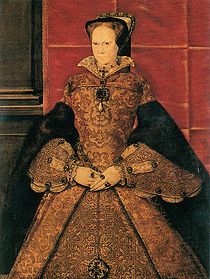
Queen Mary, a.k.a. "Bloody Mary"

Why did our ancestor Thomas Wyatt the Younger lead a revolution against Queen Mary, Henry VIII’s oldest daughter?  Watching “Elizabeth” (the Special Edition version) was an entertaining way to get some sense for it.

I believe the portrayal of Queen Mary was accurate; the actress who played her even looked like paintings of the real queen.  From what I’ve read of Mary, her health was never good and my God, what a miserable childhood.   When you think about the family dynamics, this beats anything you’d see on Springer.

Henry VIII thought little of discarding his first wife (Catherine of Aragon) when she was beyond her ability to produce live sons – just as he thought very little of declaring their daughter Mary a bastard.

Henry married Anne and had her crowned Queen of England. Per Wikipedia – “Anne had been crowned with St. Edward’s crown, unlike any other queen consort, while carrying Elizabeth. Historian Alice Hunt has suggested that this was done because Anne’s pregnancy was visible at the moment of coronation and she was carrying an heir who was presumed to be male.”

I wrote about King Edward – St. Edward – in a previous blog. he is another fascinating distant relative. He was succeeded by William the Conqueror – our immediate ancestor through Lady Elizabeth Brooke’s line. 

After Anne Boleyn gave birth to Elizabeth, Mary was forced to SERVE her little sister while being denied access to her own mother. When Catherine of Aragon died, Mary was not allowed to attend the funeral.

Elizabeth’s childhood would be even more extreme. Her mother Anne Boleyn was beheaded when Elizabeth was less than three years old.

Imagine the adult dynamic of Mary and Elizabeth – half sisters, daughters of a violent father who wanted sons.

Henry finally had a son after his third marriage to Jane Seymour – Edward VI.

Thomas Wyatt had served Henry VIII as a volunteer in wars against France between 1543 and 1550. One governor wrote Henry VIII praising Wyatt’s "hardiness, painfulness, circumspection, and natural disposition to the war".  He was given command of troops and knighted in 1547. Somewhere along the line he developed a true hatred of the Spanish.

When Henry died and was succeeded by Edward VI, Thomas returned to England and stopped taking part in public affairs.  Edward was still a child when Henry died, so Protestants ruled the court on his behalf. As Edward grew, he and his half-sister Mary got into it over religion; one record talks about an instance where Mary left an event crying. While it seems Edward had a good relationship with Elizabeth, he didn’t want Mary anywhere near the throne.

John Dudley, 1st Duke of Northumberland, convinced Edward to exclude both of his sisters from the line of succession. (This was against Henry VIII’s Act of Succession.) Dudley recommended his daughter-in-law, Lady Jane Grey, instead. She was the granddaughter of Henry VIII’s younger sister Mary Tudor, Queen of France.

Sir Thomas Wyatt was part of the movement to put Jane on the throne.

Edward died at 15 of a pulmonary infection – and/or poison. Lady Jane Grey – only 16 years old – ruled for less than two weeks before being overthrown by Mary.

Jane was Mary’s cousin and Mary knew she was an innocent pawn in a power play. Her initial treatment was kind. She was kept in decent lodging at the Tower and allowed to roam the queen’s gardens. Mary even gave her a generous allowance.

Thomas and his Protestant friends watched from the sidelines UNTIL Mary made it known that she intended to marry Felipe of Spain. The combination of Roman Catholic AND Spanish influence in England was too much for Thomas.

He accepted an invitation by Edward Courtenay, Earl of Devon, to rise up against Mary.  Thomas held a meeting at Allington Castle and ultimately managed to raise  4000 men. They marched on London in late January, 1554.

This event is known as “Wyatt’s Rebellion.”

The rebellion failed and Thomas was imprisoned. Some say his wife, Jane Hawte, was approached and told he would be spared if he would implicate Elizabeth; he refused. He was beheaded and dismembered, with his limbs spread across the countryside. His head was stolen; Mary confiscated his estates and titles and his family struggled to survive.

Wikipedia puts the times into one fairly neat package. I don’t always trust the information either, but I do enjoy the squabbling under the “Discussion” tab.

http://en.wikipedia.org/wiki/Mary_I_of_England

Mary didn’t listen to experienced members of her English court; she took her advice from Charles V of Spain. Within five days of Sir Thomas’ rebellion, she did as he suggested; she made an example of Lady Jane and her husband. Mary had Jane beheaded in private at The Tower Green, within the Tower of London. This was seen as a gesture of respect.

This account of her execution is from Wikipedia: “The executioner asked her forgiveness, and she gave it. She pleaded the axeman, ‘I pray you dispatch me quickly’. Referring to her head, she asked, ‘Will you take it off before I lay me down?’ and the axeman answered, ‘No, madam’. She then blindfolded herself. Jane had resolved to go to her death with dignity, but once blindfolded, failing to find the block with her hands, began to panic and cried, ‘What shall I do? Where is it?’ An unknown hand, possibly Feckenham’s, then helped her find her way and retain her dignity at the end. With her head on the block, Jane spoke the last words of Jesus as recounted by Luke: “Lord, into thy hands I commend my spirit!”

Lady Jane’s husband was taken from the tower and beheaded in public at Tower Hill.

With Jane gone, Mary still had to decide what to do with Elizabeth. Mary sent her to the tower for two months under the assumption she was in cahoots with Thomas.

Mary burned nearly 300 Protestants at the stake, sought the love of a husband who “wasn’t that into her” and endured the humiliation of two phantom pregnancies.

Bloody Mary died at 42 years of age and Elizabeth was crowned.  “Good Bess” started turning that sinking ship. Per Wikipedia “Elizabeth set out to rule by good counsel, and she depended heavily on a group of trusted advisers led by William Cecil,  Baron Burghley. One of her first moves as queen was to support the establishment of an English Protestant church, of which she became the Supreme Governor. This Elizabethan Religious Settlement held firm throughout her reign and later evolved into today’s Church of England.”

During the time of our ancestor George Wyatt, Queen Elizabeth restored some of the Wyatt estate.

Some say Queen Elizabeth never married because of what she remembered of her mother and father from childhood.  The movie implies she was far more noble than that. Whatever the case, Anne Boleyn’s daughter achieved some wonderful things.

Unbelievably, Mary and Elizabeth were reunited in death. Per Wikipedia we learn … “The Latin inscription on a marble plaque on their tomb (affixed there by James VI of Scotland when he succeeded Elizabeth to the throne of England as James I) translates to “Consorts in realm and in tomb, here we sleep, Elizabeth and Mary, sisters, in hope of resurrection”.

Queen Mary was a descendant of John of Gaunt – as are we.

Anne Boleyn was Lady Elizabeth Brooke’s cousin. We are descended through Lady Elizabeth Brooke, so her daughter Queen Elizabeth would have been our … cousin once removed?

Our first ancestor to set foot in America – Hawte Wyatt – was named after Lady Hawte Wyatt, daughter and heiress of Sir William Hawte of Bishop’s Borne.

This stuff just fascinates me beyond all reason.  While it barely touches on the Wyatt connection, I felt like I was there. I watched the movie three times.

Request Elizabeth, Special Edition from Netflix or order from Amazon: 

<a href=”http://www.amazon.com/gp/product/B000V6ONWO?ie=UTF8&tag=wwwamericanwy-20&linkCode=as2&camp=1789&creative=9325&creativeASIN=B000V6ONWO”>Hirschfelder: Elizabeth – Original Sound Track</a><img src=”http://www.assoc-amazon.com/e/ir?t=wwwamericanwy-20&l=as2&o=1&a=B000V6ONWO” width=”1″ height=”1″ border=”0″ alt=”” style=”border:none !important; margin:0px !important;” />

 
King Edward I of England, a.k.a. St. Edward the Confessor

King Edward I of England, a.k.a. St. Edward the Confessor

This is an informal update.
I just got back from the library. I have a shiny new library card and enough reading material to keep me out of trouble for a few days.


I am so hooked on working on this book. Every door I open opens three more. I was going to “head of the line” in Wyatt ancestry and damned if our first DOCUMENTED ancestor wasn’t Captain Guyot – who ran the fleet for William the Conqueror – who also was an ancestor through Sir Thomas Wyatt’s wife Elizabeth Brooke – whose pedigree goes further back than that.

Then I innocently lost focus due to overlap, wandered off into the world of what was and what if. Like our times, history is not black and white. Writers always had an agenda and you hope to find the truth somewhere in the middle. 

William the Conqueror was William the Bastard before he got to conquering. While researching him I discovered his father’s cousin (?) was then king of England – Edward I who would later be known as “Saint Edward the Confessor.”

What opposites.

Then I read some of Ed’s stuff. I don’t think he wanted that job, it sounds like he just wanted to go off and join a monastery.  Historians make him sound like the wimp king who gave up England to the Normans, while the Catholic church  pegs him as saint.

Did Ed have an arrangement with his wife that they would be celibate due to extreme piousness – or did he hate her because her family killed members of his family?? For most couples, that would be a dealbreaker.

And somewhere along the line Ed promised William he would succeed him to the throne if he (Ed) didn’t have heirs. ?? It didn’t sound like he had PLANS to have heirs. 

And I wondered why the saint was trying to help the bastard when I discovered that William spent his childhood dodging assassins. In one case, as a child, another boy he was sleeping with was stabbed in a case of mistaken identity. Poor kid – talk about post-traumatic stress syndrome.

I would have had a soft spot for him – or at least cut him some slack. Plus the young man was a relative on Ed’s mom’s side. Plus William grew up being called the bastard. (I kept thinking Johnny Cash’s “Boy Named Sue” – I grew up quick and I grew up mean, my fists got hard and my wits got keen ….”)

History has an account of him cutting off the hands and feet of some burghers who made the mistake of mocking. 

And poor Ed – he’s got various sides breathing down his neck and all he wants to do is realize his life’s dream – construction of Westminster Abbey.  Then he goes and has a stroke or hemorrhage in November of 1065. He misses consecration of his beloved edifice.   

Turns out by Christmas Ed was alternately delirious/comatose and was “said” to have given his throne to Harold of Somethingorever just before he died on January 4. 

King Harold was crowned (at Westminster no less) on January 6.

Who gives their throne to Harold? Bill and two other guys were furious and all hell broke loose. 

After requesting directions to books on William the Conqueror and St. Edward the Confessor, I asked the librarians where I could find books on Westminster Abbey; they looked at me like I must have been out in the parking area smoking weed. 

It is just amazing. It’s SO much fun, completely addictive.

I apologize for feeding this blog in bits and pieces, but that’s just how it’s going at this point. My next few posts will be about Bill and Ed.

Richard Wyatt left school at 14 to enlist and serve in the Revolutionary war. (This is the Wyatt who burned his family Coat of Arms – see that post.) 

On December 8, 1796 Richard Wyatt married Nancy Ware, daughter of Captain John Ware and Ann Harrison Ware. One of their sons – Richard Ware Wyatt – was born December 22, 1806. He became a colonel of the Virginia militia and was “prominently identified” with the Whig Party.

THIS IS VERY COOL. In April of 1830 Richard Ware Wyatt set out on a four month journey from Virginia to Kentucky, Illinois, Indiana, Ohio and Missouri on horseback.  Check it out.

http://jbwyatt.com/tripwest.html

On September 19, 1833, RWW married Harriet K. Harris, (born November 16, 1811). Their children were “Martha Ann, who married Theodore H. Woodard; Richard Overton, who died while in the service as a surgeon in the Confederate army; James Walter, major in the Confederate army and killed at the battle of Cold Harbor; Evalina Harris; Alice Elizabeth; Ida May (born May 1, 1846, died April 29, 1904), who married Joseph Marion Wyatt; Mary Nelson; and Kate Harrison, who married Samuel E. Wilson and (second) Rev. John W. Lea.”  (See and/or purchase the source, below.)

Richard Ware Wyatt died May 24, 1881.

Family connections are as follows:

John Wyatt (born in 1684) was a grandson of Haute Wyatt by his second wife Anne.

John Wyatt and Jennie Pamplin’s son Richard Wyatt was born May 20, 1720; (he died at “Plain Dealing” in November, 1803.)

Richard Wyatt’s first wife was Elizabeth. She died at the birth of her first child in 1744. Richard then married Amy Chiles, daughter of Walter Chiles on November 17, 1752. (Walter was a descendant of immigrant Walter Chiles who represented Charles City county in the General Assembly, was Speaker and member of the James City Council.)

Richard Wyatt and Amy Chiles Wyatt’s son Richard Wyatt was born January 1, 1762.  Richard Wyatt (II?) married Nancy Ware – daughter of Captain John Ware – on December 8, 1796. Their son Richard Ware Wyatt was born December 22, 1806.

The quotes are from Volume II of:

“Historical and Biographical Annals of Columbia and Montour Counties Pennsylvania”

Containing a Concise History of the Two Counties and a Genealogical and Biographical Record of Representative Families. (In two volumes, illustrated.)

Chicago – J.H. Beers & Co., 1915. 

The Wyatt family is on pages 913 & 914. You can also google it to read the whole thing.

<a href=”http://www.amazon.com/gp/product/114728119X?ie=UTF8&tag=wwwamericanwy-20&linkCode=as2&camp=1789&creative=9325&creativeASIN=114728119X”>Historical and Biographical Annals of Columbia and Montour Counties, Pennsylvania, Containing a Concise History of the Two Counties and a Genealogical … Record of Representative Families …</a><img src=”http://www.assoc-amazon.com/e/ir?t=wwwamericanwy-20&l=as2&o=1&a=114728119X” width=”1″ height=”1″ border=”0″ alt=”” style=”border:none !important; margin:0px !important;” />