Feeds:
Posts
Comments
Wyatt Coats of Arms

Wyatt Coat of Arms

Richard – son of Captain John Wyatt (1684) and Jane Pamplin made history for burning the family coat of arms. 

This excellent site helped me establish his relation within our family tree – check it out when you get a chance: http://jbwyatt.com/history.htm)

The following is from A History of Caroline County, Virginia by Marshall Wingfield: page 490.
(I ordered this book for my library;  I have a link to it below.)

“The Wyatt Family

The Wyatt family of Virginia descends from the distinguished English line of Sir Thomas Wyatt, courtier and poet. Just preceding the Revolution, Richard Wyatt, (1720-1803), at his home in Caroline county, becoming incensed at the Mother Country, tore the family Coat of Arms from the wall, and, hacking it from the frame with his sword, threw it on the blazing logs in the fireplace. It was rescued by his daughter, Nancy, who later became the second wife of Colonel Anthony New. When they removed to Kentucky, the treasured painting went with them. In the year 1830, a descendant seeing the old relic in their Kentucky home made a little sketch of the design. Though blackened by fire and smoke, there were still to be plainly seen bands of boar’s heads on the shield similar to the Arms of Sir Thomas Wyatt of England. The painting was later totally destroyed by fire, but the little sketch is still in the family.”

If you cruise the ‘net, you may find a copy of the drawing. I remember seeing it, but forgot to make a copy.

More about Richard Wyatt: He was born May 20, 1720, died at “Plain Dealing” in November, 1803. His first wife was Elizabeth Streshley, who died at the birth of her first child in 1744. Richard then married Amy, daughter of Walter Chiles on November 17, 1752. Walter was a descendant of immigrant Walter Chiles who represented Charles City county in the General Assembly, was Speaker and member of the James City Council.

Click to order “A History of Caroline County, Virginia” by Marshall Wingfield:

<a href=”http://www.amazon.com/gp/product/0788409387?ie=UTF8&tag=wwwamericanwy-20&linkCode=as2&camp=1789&creative=9325&creativeASIN=0788409387″>History of Caroline County, Virginia (A Heritage classic)</a><img src=”http://www.assoc-amazon.com/e/ir?t=wwwamericanwy-20&l=as2&o=1&a=0788409387” width=”1″ height=”1″ border=”0″ alt=”” style=”border:none !important; margin:0px !important;” />

We’re related to Jerry Lawson through marriage.  Allow me to bore you with the details … Martha Simpson was born in 1827. She was the daughter of Emily Parmelia Wyatt and Moses Simpson; Emily’s parents are our direct line, Henry Wyatt and Elizabeth Redd.

On October 19, 1841, Martha married Josiah F. Tinney, a veteran of the War of 1812. Their son John Henry Tinney, was born February 23, 1844 in Harrison County, Kentucky.  On March 5, 1867 he married Louisa Lawson, daughter of Jerry and Nancy Lawson. John Henry fought during the Civil War, as did his father-in-law Jerry Lawson.

Tradition states “It is told of Jerry Lawson, that he couldn’t hear good and at the Battle at Cynthiana, they were shooting from inside the Courthouse and they gave the word to surrender. He didn’t hear it and kept on shooting, so they shot him.”

Molly Pitcher at the Battle of Monmouth

Molly Pitcher at the Battle of Monmouth

During the battle Molly Pitcher, the wife of an American gunner officer, is said to have taken over the firing of her husband’s cannon, when the crew became casualties.

Henry Wyatt was born in 1759 in King and queen City, VA.

Henry served in the 7th VA Regiment “under Colonel Health of the Continental Line under Captain Hill for 1 year”.

He fought in the Battle of Monmouth.  Record of his service can be found in Revolutionary War Rolls, compiled 1894 – 1913, documenting the period 1775 – 1783

Learn about the battle: 

http://www.britishbattles.com/battle-monmouth.htm

Here are some excerpts …

“General Washington, bringing the main American army along the Monmouth road, encountered, not the rear of the British column, but Lee’s regiments, retreating in considerable disorder with the British advancing behind them.

Memorably this is the one occasion Washington is said to have sworn. He deployed a consignment of oaths directed at Lee, to the admiration of those listening, before ordering Lee to the rear. Washington then galloped forward and began the task of rallying Lee’s disordered troops.

Some US authorities categorise Lee as a traitor. Lee is a strange and interesting character. He first arrived in America as a captain in Halkett’s 44th Regiment, taking part in Braddock’s disastrous march to the Ohio River during 1755. Lee continued to serve during the French and Indian War. He was given the nickname of “Boiling Water” by the Iroquois due to his temper. He was also the subject of an assassination attempt by members of his regiment.

The British suffered some 300 casualties and the Americans 350. Up to 100 men are thought to have died of heatstroke during the battle.”

Overall, the battle was considered a bit of a wash with no real victor.

After the war Henry married Elizabeth Redd on June 9, 1787 in Spotsylvania. VA. “Cousin” Bonnie Snow provided the following – thank you Bonnie!

The marriage bond of Henry Wyatt and Elizabeth Redd …

Sir,
Please to issue Henry Wyatt license for to marry my daughter Elizabeth Redd. June 9,1787
 Elizabeth Redd

Know all men by these presents that we Henry Wyatt and P.D. Redd are held and firmly bound unto Sam’l Randolp Esq., Governor of this state and to his successors in the sum of fifty pounds to the payment of which will ( ) to be made, we bind ourselves jointly and severally firmly by these presents. Sealed this 11th day of June 1787. The Cond’n is such that whereas J. Chew Jr. clk of the County Court of Spotsl. hath this day issued a license for the marriage of the above named Henry Wyatt unto Elizabeth Redd of the said County. Now if there be no lawful cause to obstruct said marg’e and then the above obligation to be void.

Henry Wyatt (SEAL)
Phillip D. Redd (SEAL)

As I understand it, Revolutionary War veterans were given land in Kentucky. Henry Wyatt moved to Pendleton County in the early 1800s. He had a plantation of approximately 500 acres.

Henry Wyatt applied for his Revolutionary Pension (W-836)  in Pendleton County, Kentucky on October 19, 1819.  His stated age was 60 years old and he reported serving in King & Queen County, Virginia.

He died October 4, 1824 in Pendleton City, Kentucky. At the time of his death he left 8 slaves, 325 acres of land – and a widow who had to fight long and hard to get his pension. 

(My family had the following, as did “cousin” Bonnie Snow.)

“HENRY WYATT & ELIZABETH REDD WYATT
W.836
KENTUCKY

Rev. & 1812 Wars Section
September 17, 1926

Mrs. R. B. Browder

Madam:

I have to advise you that is appears from the papers in the Revolutionary War pension claim, W. 836, that HENRY WYATT enlisted in King & Queen County, Virgina, in 1777 and served on year as a private in Captain Thomas Hill’s Company in Colonel Heth’s Virginia Regiment and he was in the battle of Monmouth.

He was allowed pension on his application executed October 19, 1819 at which time he was sixty-six years of age and was a resident of Pendleton County, Kentucky.

He died December 27, 1823.

He married in 1787 in Spottsylvania County, Virginia, Elizabeth Redd.  She was allowed pension on her application executed November 1, 1837, while a resident of Pendleton County, Kentucky, and at that time she was over seventy years of age.

Henry and Elizabeth Wyatt had the following children:  Mordecai who was the oldest, Parmelia, James, Philip, Betsey, Henry, Nancy, Agnes, Beverly, John and Sally.

Respectfully,
E. W. Morgan
Acting Commissioner”

Emily Permelia Wyatt (noted in the Revolutionary pension document) was born about 1795.  She married Moses Simpson and one of their children was Martha Simpson, born in 1827.   She married Josiah F. Tinney on October 19, 1841. Josiah was in the War of 1812.

Their son John Henry Tinney was in the Civil War. Martha’s letter to her son at this time is heartbreaking.

See my other post for details. If you have information to share, please contact me!!!

Martha Simpson was born in 1827. She was the daughter of Emily Parmelia Wyatt and Moses Simpson; Emily’s parents are our direct line, Henry Wyatt and Elizabeth Redd.

On October 19, 1841, Martha married Josiah F. Tinney, a veteran of the War of 1812. Apparently he kept a pocketbook that meant a lot to him.

The following is from my mother’s records, it was hard to tell where the actual quotes started and ended. I did my best. And the typos are theirs, not mine.

“Josiah F. Tinney enlisted in Mason Co., Ky., in the service of the United States as a Regular Soldier about the time and previous to the War of 1812; that he never returned until about 1840. The pocketbook of Josiah F. Is still extant, with the following written: Josiah F. Tinney, his hand and pen he will be good but God noes when Do not steal this pocket book for shame.  Josiah F. Tinney, 15 Aug 1812 – Chester Co., Pa.; Josiah F. Tinney his pocketbook. He was b. in Alleghany Co., (Va.) he is thirty years of age the 8th day of April l1816 his father was born in Maryland in Harford Co., and his mother was born in Pa. in Chester Col, on Brandywine Creek and anyone fines this noat book will oblidge me and bring it in Harford Co. 3 miles below lower crossroad.”

Martha Simpson was born in 1827. She was the daughter of Emily Parmelia Wyatt and Moses Simpson; Emily’s parents are our direct line, Henry Wyatt and Elizabeth Redd.

On October 19, 1841, Martha married Josiah F. Tinney, a veteran of the War of 1812. Their son John Henry Tinney  fought for the north during the Civil War.

This is from my mother’s records, exactly as written, complete with typos. It’s an exceptional glimpse at what it felt like to worry about a son who’d gone off to fight. 

“Josiah and Martha had a son, John Henry Tinney, who fought in the Civil War on the union side and, due to exposure, etc., he died early. A letter written by ‘Mrs. Martha tinney to here son John tiney,’ states: (dated December the 8 1863) deare sun I take my pen in han to drop you a few lin to in form you that I received your welcome leter the of the first od December and its fond me as well as comin I hope these few lin my find you well and enjoin good health I have bin lokin for you for some time bute ite seme like I will neve git to see you bute I hope you will soon come home and see me I heard you had oders to leve there and I want you to ride to me and tell me where you are goin I hope you will come nere home instid of goin farther for you are fare enough from now I wante you to bee a good boy and serve your lord the best you can and I wante you  not to play cards I herde some say you had took to plain cards and if you have for my sake never tech them I wante to see you very bad bute I wante you never to desert I wants you to come like a gentleman when you come there is nothing on this earth that wold satisfy me as well as to bee with you ate home in peace I hope you will soon come we wose all most crasey about the other day bute I hope the beter is yet to come I hope you and all of you will live to come home agin again I hope the rebels won’t kill none of you I never hardly sware bute I hope dam there infernil haste of them I hope you and all the rest may kill them all and then we will have peace when all the rebel devils is dead I want you to ride as soon as you gite this leter and let me now how you are gitin along mus close I remane you mother until death.”

Martha’s son made it home but died young as a result of wounds he sustained in battle. 

So sad. Go hug somebody.

The Other Tudors

The Other Tudors

I’ve seen “The Other Boleyn Girl” based on the book by Philippa Gregory. I don’t remember the details, so I rented it again.
http://www.youtube.com/watch?v=oUZojhOdphg

Haven’t watched it yet – I’ve been too busy with a book I purchased at the same time, “The Other Tudors – Henry VIII’s Mistresses and Bastards” by Philippa Jones.  (See a link for purchase at the bottom of the page.)

It sounds steamy, but it’s not. Leave that to the romance novelists – I’m after facts. I don’t like seeing our ancestors portrayed inaccurately in books and movies. Philipa Jones’ book clarifies a lot of misconceptions while throwing more ladies (and bastards) into Henry’s mix. 

I quickly learned that Anne did not lure HenryVIII away from Mary as shown in the movie. In fact, the movie has Mary in seclusion in the late stages of her pregnancy as Anne and Henry begin their relationship.  I remember one scene where she’s holding her newborn baby – the king’s child – as he turns his back and walks away with Anne. It makes for good drama, but it couldn’t be further from the truth.

According to this book Mary’s affair had been over for three years before Anne caught his eye.  

“The affair between Henry and Mary Boleyn ended some time in 1525. It was not until 1528 that Mary’s sister, Anne, is mentioned as having taken the King’s fancy. He did not abandon one sister for another.” 

If Harry wanted a woman, he set up a suitable marriage and pretty much told the groom to stand back; which they were more than willing to do in return for generosity that included a beautiful wife.

The books talks about Mary falling out of favor with her own father. She had to maneuver behind the scenes to get Henry VIII to intercede on her behalf and guilt her father into giving her enough money to survive.  

And I don’t know if any movies have broached this aspect. “Despite the sisters being at odds, the closeness of the Boleyn family was noticed and utilised. When Anne miscarried in January 1536, Francis I was told the story, also reported by Chapuys to Charles V, that Anne was not really pregnant at all. She and her sister Mary had invented the story between them to keep Henry believing that Anne could give him the son he wanted.”

It’s also interesting to note that whereas Sir Thomas Boleyn is referred to in fiction as someone who used his daughters like pawns for personal gain, this book reminds us that his relationship with Henry VIII stood on it’s own merit. 

The book is well laid out, with reference trees preceding the chapters. Dates and details seems  a little convolulted, it’s hard work. It does seem that half of the people involved in intrigues at court are related to Sir Thomas Wyatt’s line or Elizabeth Brooke’s line in one way or the other; even Henry VIII.  In fact, Henry’s grandmother Margaret Beaufort … well, she got him laid. She personally chose the first woman he went to bed with before marriage. (The relation comes to us through Elizabeth Brooke.)

Understand that … “An affair with a royal prince was not disgraceful, and could lead to prosperity for a noble family. The lady might expect to receive favours, both financial and in property, an arranged marriage with a substantial dowry if she was single, and there could be positions at court for her family. If a royal mistress had a son, the child could expect an earldom and possibly a dukedom, with a chance that either he or his descendents woujld inherit the throne.”

Also, life expectancy was 35; these people lived faster and harder than we do today.

I do recommend the book:

The Other Tudors – Henry VIII’s Mistresses and Bastards”
by Philippa Jones.
 

<a href=”http://www.amazon.com/gp/product/1847734294?ie=UTF8&tag=wwwamericanwy-20&linkCode=as2&camp=1789&creative=9325&creativeASIN=1847734294″>The Other Tudors: Henry VIII’s Mistresses and Bastards</a><img src=”http://www.assoc-amazon.com/e/ir?t=wwwamericanwy-20&l=as2&o=1&a=1847734294” width=”1″ height=”1″ border=”0″ alt=”” style=”border:none !important; margin:0px !important;” />

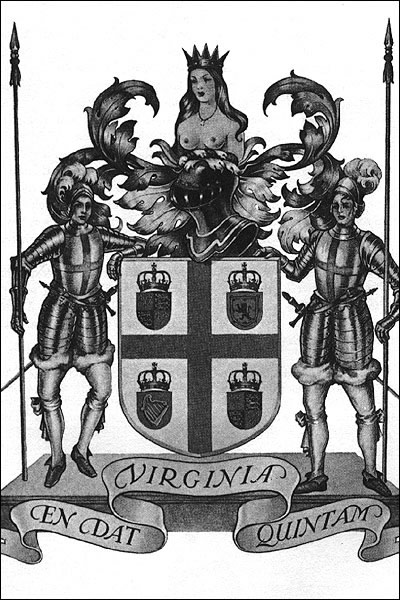
The Virginia Company Coat of Arms

The Virginia Company Coat of Arms


Photo Credit:
Virtual Jamestown, Virginia Center for Digital History, UVA 

My fascination for our Wyatt connection to Jamestown continues to grow.

I have no idea what Hawte and Sir Francis Wyatt knew of life in Jamestown as they made their plans to come over, but I suspect they assumed the worst was over.

They were wrong, of course.  

I rented a great video from Netflix – “National Geographic: The New World – Nightmare in Jamestown.”  Some of the following is from that. (This is raw material for my book, it’s fun to share.)

Do you realize:

Europeans had already been visiting this area of the new world for 100 years.

Spanish Jesuits established a mission in the Chesapeake Bay area in the 1570s; the natives killed them off in a few months.

In 1590, an English captain who returned with supplies (for the second attempt at a settlement) found everyone had disappeared without a trace.

In December of 1606 105 upper class Englishmen and workers left England for the new world on the Susan Constant, Godspeed and Discovery. One passenger died en route. Internal fighting started on the ships. There wasn’t much wind, so the journey across the Atlantic took four months instead of the usual three. That would try anyone’s patience. And then they had unrealistic expectations.

They didn’t fear the natives, they expected the natives would trade food for beads. As a result, they didn’t bring much in the way of supplies. (You have to wonder where they got their information on the native people.)

The natives were pissed at first sight. Powhatan had heard a prophecy that warned of a people who would come from the water; he was not amused.

The English  feared the Spanish and docked their ships far upriver so they wouldn’t be spotted. Of course that left them surrounded by 14,000 Native Americans.

The English assumed technological superiority with their guns, but the natives could shoot ten arrows in the time it took to pull off one musket shot.

They had no clue about the climate and weren’t dressed for the weather; they wore wool and armor.

They arrived during the worst drought in many years. They were drinking water from the river, which was increasingly brackish. It’s thought this is probably why some died. 

They feared Spanish spies within their ranks. According to the National Geographic video, that wasn’t the paranoia talkin’.

The upper class Englishmen didn’t want to share the work. In 1608 Captain John Smith instituted a “no work, no food” policy.

In October of 1608 the first two Englishwomen arrived with the second shipment of men and supplies. They were Mistress Forrest and her maid Anne Burras, who was 14. Anne’s marriage to a man ten years older was the first wedding in the new land. She and her husband went on to raise four daughters.

This is interesting, archaeologists think they found Mistress Forrest:
http://www.archaeology.org/9903/newsbriefs/jamestown.html

The winter of 1609 and 1610 was “the starving time.” 200 people ate dogs, cats, horses and poisonous snakes. Some even dug up corpses. One husband killed his wife and ate her. (He was burned to death for his crime.) That winter only 60 people survived.

Captain Smith bravely negotiated trade with Powhatan for the food that saw them through. Still, relations remained strained.

“Relations between the Powhatans and the English grew less friendly as the settlers moved to expand the colony. Settlers began to attack Indian villages, in some cases burning homes and fields. In one instance, they not only destroyed the whole town of Paspahegh, but also killed every Indian including women and children. This broke the most basic rule of warfare for the Powhatans and their attacks on the English became more severe. The situation continued to worsen until a colonist captured Pocahontas, a favored daughter of the chief Powhatan, in April 1613. She was taken to Jamestown where she remained a hostage for about a year, learning English and marrying her tutor, John Rolfe. Their marriage helped to secure a peace agreement between the two cultures for a while. This period of peaceful relations came to an end after the death of Pocahontas in England and the return of John Rolfe and other colonial leaders in May 1617. Disease, poor harvests and the growing demand for tobacco lands caused hostilities to resume.” 
http://www.personal.kent.edu/~dfriend/powhatan.htm

By 1619, the colony was seeing profit from the sale of tobacco. The company gave the men land to build homes, but they had no women. So the company (The Virginia Company of London) arranged for mail order brides; the brides were paid for with tobacco. 

That year the Virginia Company said that “…a fit hundredth might be sent of women, maids young and uncorrupt, to make wives to the inhabitants and by that means to make the men there more settled and less movable….”  In 1620 the Virginia Company sent 90. In may of 1622 company records stated that “57 young maids have been sent to make wives for the planters, divers of which were well married before the coming away of the ships.”

Nice logo (“coat of arms”) Virginia Company. Tobacco leaves(?)  and hooters?!  There was sex in marketing even then. Well, I guess it was truth in marketing if you could trade your crop for a wife.

Our family arrived the following year. Hawte, Barbara and their infant son Edward accompanied Hawte’s older brother, Sir Francis Wyatt on the journey across the Atlantic to Virginia.  They sailed from England on August 1, 1621 on the “George.” 

For frame of reference, understand that THE FIRST PILGRIMS ARRIVED IN PLYMOUTH JUST ONE YEAR EARLIER. 

 Barbara must have been in the early stages of pregnancy during the crossing.  I wonder if she simply thought she was seasick. 

They arrived in October of 1622. Barbara was about three months pregnant.

What was it like in Jamestown at that time?  “For the first twenty years or so, Jamestown dwellings were ‘rude shanties of such green timber and poor workmanship that they were constantly decaying.’(15) http://www.nwhm.org/online-exhibits/jamestownwomen/15.htm

The Indian massacre of Good Friday took place in March of 1622 – within five months of our family’s arrival.

“The paramount chief Powhatan died soon after in 1618 and the mantle of power passed officially to his brother Opitchapam, but it was a second brother Opechancanough who held the real authority. Opechancanough led a major raid on English settlements in March 1622, assuming that the English would react to such a brutal attack in Indian fashion and withdraw from the area altogether. Instead the colonists sent for reinforcements and counter-attacked.”
http://www.personal.kent.edu/~dfriend/powhatan.htm

Barbara had to have been heavy with child when 347  English men, women and children were killed throughout the Virginia colony. That was about one third of Jamestown’s total population.

Sir Francis Wyatt “rallied the defense of Jamestown which was attacked by Native Americans, during which the lives of some 400 settlers were lost and he then oversaw the contraction of the colony from scattered outposts into a defensive core.”
http://www.spiritus-temporis.com/francis-wyatt/

Barbara and Hawte gave birth to the first American born Wyatt – George – shortly after the massacre.  Ladies, imagine going into labor in a place like that – after a tragedy of that magnitude. 

“Childbirth was very dangerous for women. Jamestown was a de facto wilderness, and few trained doctors or midwives were available. Instead, female neighbors and relatives helped women through their labor.

Mothers had to steel themselves emotionally to the strong possibility that their babies would die. Disease spread easily, and so few sicknesses could be cured that children born in Jamestown had only a fifty percent chance of growing to adulthood. One quarter of infants born alive died before their first birthday. Worse, if a child did survive its early years, it was likely that he or she would never know at least one parent. By the age of nine, most children had lost one or even both parents. Orphans were a fact of ordinary life in Jamestown.”
http://www.nwhm.org/online-exhibits/jamestownwomen/16.htm

In 1625 Sir Francis, his brother Hawte and Hawte’s wife and two small sons returned to England to settle their father’s estate.

In 1639 Sir Francis returned to Jamestown to become Governor for a second time. He brought Reverend Hawte’s three sons and a daughter back with him. They are our American ancestors.

I hope you’ll take time to rent the National Geographic video. It helps us appreciate what they went through in those times.

I thought it would be fun to do this history in timeline format. Our ancestors are in bold. Note that this is just a working draft, help if you have something to share.

Chief Powhatan

Chief Powhatan

1585
The first English expeditions to Virginia (featuring Sir Walter Raleigh) occur in 1585 and 1589. Neither attempt ends well. In fact, colonists of the second attempt disappear without a trace.

1607
Arrival of the first colonial settlement with staying power
Near-instant problems with Powhatan, his people and their allies.
John Smith (one of a nine person governing panel) is captured by Powhatan’s people. I am aghast to learn that Pocahontas is just more Disney fiction. She would have been pre-pubescent at this time. Also Powhatan had no reason to kill Smith, he was just meandering up a waterway trading for corn.

1610
Timing is everything; the colonists’ was bad. The area was enduring a multi-year drought.  That winter – out of more than 400 people – only 60 survived. Some colonists attacked the natives for food. Some stole food from the fort and carried it off to eat while taking up residence with the natives. A few were so desperate, they dug up at least one fresh grave and resorted to cannibalism.

1611
John Rolfe discovers Virginia is a great place to raise tobacco; smokes were already extremely popular in Europe and the Spanish own the market. Well, not after John Rolfe. Eureka, the Jamestown Colony finally found a way to make a few bucks.
Unfortunately, they will need more land.
Uber-unfortunate – the land is owned by Powhatan’s people and their allies. Things get really bad; again.

1613
The colonists abduct Pocahontas – one of Powhatan’s favorite children – in an attempt to squeeze him for more land. What a bunch of schmucks.

1614
John Rolfe writes a letter to the governor begging for her release. Apparently they have “a thing.” I dunno, need to do more research. This is making me feel really dumb.
John and Pocahontas marry and relationships between the colonists and natives improve; for a while.

1619
A Dutch privateer brings the first African slaves. Hopefully he’s somewhere in Dante’s seventh circle of hell.

1619
In England I assume – “Sir Francis Wyatt organized the General Assembly which had been called in 1619. This was the first legislative body in America. Sir Francis caused its privileges to be embodied in a written constitution, the first of its kind in the New World.
See http://www.spiritus-temporis.com/francis-wyatt/

1621
Our people arrive in Jamestown –  Hawte, Barbara and their infant son Edward (born in 1619) accompany Hawte’s older brother, Sir Francis Wyatt, to Virginia
They sail from England on August 1, 1621 on the “George.” Sir Francis Wyatt brings the first written constitution for an English colony because he is destined to become the first English colonial governor of Virginia.
In October Sir Francis Wyatt becomes the first colonial governor loyal to the king.
Hawte serves as Rector of the church at Jamestown (1621-1625).  

1622
The first American-born Wyatt is delivered. Hawte’s second son, George, was “born in Jamestown shortly after the Indian massacre of Good Friday in March, 1622.” http://freepages.genealogy.rootsweb.ancestry.com/~dotsfamilypage/dots_page/Rev_%20Haute%20Wyatt%20page.html
Sir Francis Wyatt “rallied the defense of Jamestown which was attacked by Native Americans, during which the lives of some 400 settlers were lost and he then oversaw the contraction of the colony from scattered outposts into a defensive core.”
http://www.spiritus-temporis.com/francis-wyatt/

1624 & 5
“Virginia became a royal colony in 1624, but Sir Francis, at the request of the crown, remained on as governor until September 18, 1625, when Sir George Yeardley, whom he had succeeded, resumed the office. In 1624, Wyatt resided in Jamestown with his wife, his brother Haute, and seventeen servants. In 1625, he received a black servant girl after a court settlement from her previous employer.” Ugh.
A Study of the Africans and African Americans on Jamestown Island and at Green Spring, 1619-1803…”
http://www.spiritus-temporis.com/francis-wyatt/

1625
Thomas Wyatt is born to Reverend Hawte and Barbara. (Where? In Jamestown or England?)  Thomas only lives to age 7.
The Wyatts return to England. “In 1625 he (Hawte) returned to England with Sir Francis and helped settle their father’s  estate, and served as vicar of Boxley, Kent until his death July 31, 1638.” 
http://freepages.genealogy.rootsweb.ancestry.com/~dotsfamilypage/dots_page/Rev_%20Haute%20Wyatt%20page.html

1626
Reverend Hawte Wyatt’s wife – Barbara Elizabeth Mitford Wyatt – dies 10/1/1626. She is buried in Boxley, Maidstone, England.

1630
Reverend Hawte and second wife Ann Cocke or Cox have son John Wyatt, born in Boxley.

1631 or 2
Reverend Hawte and Anne Cocke or Cox have a daughter, Anne, who never went to America.

1639
When Sir Francis returns to Jamestown to become Governor a second time, he brings Rev. Haute’s three sons and a daughter back to America with him; they become ancestors of most of the Wyatts in America.  As far as can be learned, none of Sir Francis’s children settled in America.  (I think I got this from Wikipedia.)

I’m still fleshing this out, will probably edit this page extensively.

Really cool links for you to check out:
http://www.preservationvirginia.org/rediscovery/page.php?page_id=6
http://www.history.com/interactives/jamestown-exhibit

About

Maybe we’re distant cousins?

I’m a freelance marketing writer (and author) in South Fort Myers, Florida. When I’m between projects, I work on “our” book.

The summer of 2010 was the first chance I had to spend hours and days fleshing out the history of the Wyatts. It’s incredible stuff. I wasn’t sure where to go with it, but it started developing a life of its own.

My first book will be about Sir Henry Wyatt, Sir Thomas Wyatt the Poet and his son Sir Thomas Wyatt the Younger. Their connections with Henry VII, Henry VIII and Mary Tudor were dramatic. I’m working with a giant chronology of people and events and hundreds of pages of notes, so please be patient!

My goal is that this history be something we can all be proud of – as factual as is possible with such contradictory information – easy to read and entertaining.

Stay tuned. All blessings … Micki

Micki Suzanne LeCronier

FORNJOT “THE ANCIENT GIANT”, KING OF FINLAND AND KVENLAND

Born about 530
Father of Kari

“Themorrisclan.com” says: “Old Russian tales tell of a Finnish prince who hired a giant to help him conquer Russia from Estonia to Kiev. The giant’s name was Calewa (Kaleva). After finishing this task the prince gave the giant Kvenland as his own kingdom.”

Research suggests that Fornjot was:

– A giant  (jötun), as indicated by his name
– Finland’s first and most powerful ruler
– Kalev of the Kalevala, the epic poem of Finland
– The first known direct paternal ancestor of William I of England
– A terminal ancestor of many European noble families and modern Icelandic families

He was:

– The subject of the Fundinn Noregr, the History of Norway
– Written about in Sagas of the Orkneyingers

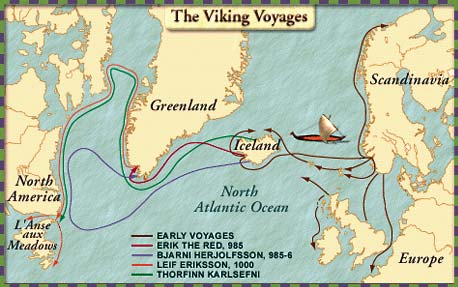
Viking voyages

Viking voyages

THE ORKNEYINGERS’ SAGA

This is the history of the capture of the Orkney Islands in Scotland by the King of Norway. It combines oral tradition with historical fact.

The saga was translated from Norse to English by George W. Dasent in 1894.

(The following portion relates to King Fornjot and his sons.)

1.  There was a king named Fornjot, he ruled over those lands which are called Finland and Kvenland;  that is to the east of that bight of the sea which goes northward to meet Gandvik;  that we call the Helsingbight.  Fornjot had three sons;  one was named Hler, whom we call Ægir, the second Logi, the third Kari;  he was the father of Frost, the father of Snow the old, his son’s name was Thorri;  he (Thorri) had two sons, one was named Norr and the other Gorr;  his daughter’s name was Goi.  Thorri was a great sacrificer, he had a sacrifice every year at midwinter;  that they called Thorri’s sacrifice;  from that the month took its name.  One winter there were these tidings at Thorri’s sacrifice, that Goi was lost and gone, and they set out to search for her, but she was not found.  And when that month passed away Thorri made them take to sacrifice, and sacrifice for this, that they might know surely where Goi was hidden away.  That they called Goi’s sacrifice, but for all that they could hear nothing of her.  Four winters after those brothers vowed a vow that they would search for her;  and so share the search between them, that Norr should search on land, but Gorr should search the outscars and islands, and he went on board ship.  Each of those brothers had many men with him.  Gorr held on with his ships out along the sea-bight, and so into Alland’s (1) sea;  after that he views the Swedish scars far and wide, and all the isles that lie in the East salt sea;  after that to the Gothland scars, and thence to Denmark, and views there all the isles;  he found there his kinsmen, they who were come from Hler the old out of Hler’s isle, (2) and he held on then still with his voyage and hears nothing of his sister.  But Norr his brother bided till snow lay on the heaths, and it was good going on snow-shoon.  After that he fared forth from Kvenland and inside the sea-bight, and they came thither where those men were who are called Lapps, that is at the back of Finmark.  But the Lapps wished to forbid them a passage, and there arose a battle;  and that might and magic followed Norr and his men;  that their foes became as swine (3) as soon as they heard the war-cry and saw weapons drawn, and the Lapps betook themselves to flight.  But Norr fared thence west on the Keel, (4) and was long out, so that they knew nothing of men, and shot beasts and birds for meat for themselves;  they fared on till they came where the waters turned to the westward from the fells.  Then they fared along with the waters, and came to a sea;  there before them was a firth as big as it were a sea-bight;  there was a mickle tilths, and great dales came down to the firth.  There was a gathering of folk against them, and they straightway made ready to battle with Norr, and their quarrel fared as was to be looked for.  All that folk either fell or fled, but Norr and his men overcame them as weeds over cornfields.  Norr fared round all the firth and laid it under him, and made himself king over those districts that lay there inside the firth.  Norr tarried there the summer over till it snowed upon the hearths;  then he shaped his course up along the dale which goes south from the firth;  that firth is now called Drontheim.  Some of his men he lets fare the coast way round Mæren;  he laid under him all withersoever he came.  And when he comes south over the fell that lay to the south of the dalebight, he went on still south along the dales, until he came to a great water which they called Mjösen.  Then he turns west again on to the fell, because it had been told him that his men had come off worsted before that king whose name was Sokni.  Then they came into that district which they called Valders.  Thence they fared to the sea, and came into a long firth and a narrow, which is now called Sogn;  there was their meeting with Sokni, and they had there a mickle battle, because their witchcraft had no hold on Sokni.  Norr went hard forward, and he and Sokni came to handstrokes.  There fell Sokni and many of his folk.

2.  After that Norr fared on into the firth that goes north from Sogn.  There Sokni had ruled before in what is now called Sokni’s dale.  There Norr tarried a long time, and that is now called Norafirth.  There came to meet him Gorr his brother, and neither of them had then heard anything of Goi.  Gorr too had laid under him all the outer land as he had fared from the south, and then those brothers shared the lands between them.  Norr had all the mainland, but Gorr shall have all those isles between which and the mainland he passes in a ship with a fixed rudder.  And after that Norr fares to the Uplands, and came to what is now called Heidmörk (5);  there that king ruled whose name was Hrolf of the Hill;  he was the son of Svadi the giant from north of the Dovrefell.  Hrolf had taken away from Kvenland Goi, Thorri’s daughter;  he went at once to meet Norr, and offered him single combat;  they fought long together and neither was wounded.  After that they made their quarrel up, and Norr got Hrolf’s sister, but Hrolf got Goi to wife.  Thence Norr turned back to the realm which he had laid under him, that he called Norway;  he ruled that realm while he lived, and his sons after him, and they shared the land amongst them, and so the realms began to get smaller and smaller as the kings got more and more numerous, and so they were divided into provinces.

3.  Gorr had the isles, and for that he was called a sea-king;  his sons were they Heiti and Beiti, they were sea-kings and mighty overbearing men.  They made many inroads on the realm of Norr’s sons, and they had many battles, and now one, now the other won the day.  Beiti ran into Drontheim and warred there;  he lay where it is now called Beitsea and Beitstede;  thence he made them drag his ship from the innermost bight of Beitstede, and so north over Elduneck, that is where the Naumdales come down from the north.  He sat himself on the poop and held the tiller in his hand, and claimed for his own all that land that then lay on the larboard, and that is many tilths and much land.  Heiti, Gorr’s son, was father of Sveiði the sea-king, the father of Halfdan the old, the father of Ivar the Uplanders’ earl, the father of Eystein the noisy, the father of earl Rognvald the mighty and the wise in council. (6)

4.  Earl Rognvald joined Harold fair-hair when he seized the land, but he (Harold) gave him lordship over both the Mæren and Romsdale; (7) he had to wife Ragnhilda the daughter of Hrolf nosy;  their son was Hrolf who won Normandy, he was so tall that horses could not carry him;  for that he was called Ganging-Hrolf;  from him are come the Rouen Jarls and the English Kings;  their son was also Ivar, and Thorir the silent.  Rognvald had also base-born sons, their names were Hallad and Hrollaug and Einar, he was the youngest.  Harold fair-hair fared one summer west across the sea to chastise the Vikings, when he was weary at the peacelessness of those who harried in Norway in summer, but were in the winter in Shetland or the Orkneys.  He laid under him Shetland and the Orkneys and the Southern Isles;  he fared west too as far as Man, and laid waste the tilths of Man.  He had there many battles, and took as his own lands so far west that no king of Norway has ever owned land further west since.  And in one battle, Ivar, son of earl Rögnvald, fell.  But when king Harold sailed from the west, then he gave to earl Rognvald, as an atonement for his son, Shetland and the Orkneys;  but earl Rognvald gave both lands to Sigurd his brother:  he was one of king Harold’s forecastle men.  The king gave Sigurd the title of earl when he went from the west, and Sigurd stayed behind there in the west.

1.  The sea in which are the Åland Isles in the Gulf of Bothnia.

2.  Now Læssö in the Cattegat.

3.  That is, were panic stricken and rushed wildly about.

4.  Keel:  The ridge of mountains which forms the watershed, backbone, or keel, between Sweden and Norway.

5.  Now Hedemark.

6.  He was called Rognvald the mighty and wise in council, and men say both were true names.” R. L.

7.  Both the Mæren” are North and South Mæren, which are divided the one from the other by the Romsdale firth.  They stretch north-eastward along the coast from Stadt to Naumdale.”

For sources and more information, please see:

http://www.webexhibits.org/vinland/archeological.html
http://alignment2012.com/fornjot.html
http://www.themorrisclan.com/GENEALOGY/FORNJOT.html
http://en.wikipedia.org/wiki/King_of_Kvenland
http://www.geocities.com/missourimule_2000/kingsoffinland.html
http://mypages.allwest.com/~rognan/genealogy/pafg3064.htm#75451
http://www.sacred-texts.com/neu/ice/is3/is302.htm
http://oaks.nvg.org/an6ra16.html